What actually is mosto?
If you’ve spent time in Spain, there’s a decent chance you’ve been confused by mosto at least once. You asked for it in a bar in La Rioja, expecting something alcoholic, and got a glass of cold grape juice. Or you ordered it in Jerez and discovered halfway through that it most definitely was not grape juice. Maybe someone at a fiesta handed you a cup and watched your face very carefully when you took the first sip.
Here’s the honest answer: mosto in Spain can mean two completely different things, and most articles in English only tell you half the story. Let’s fix that — and then we’ll tell you about the version made right here in the mountains around Ronda, which is something genuinely special.
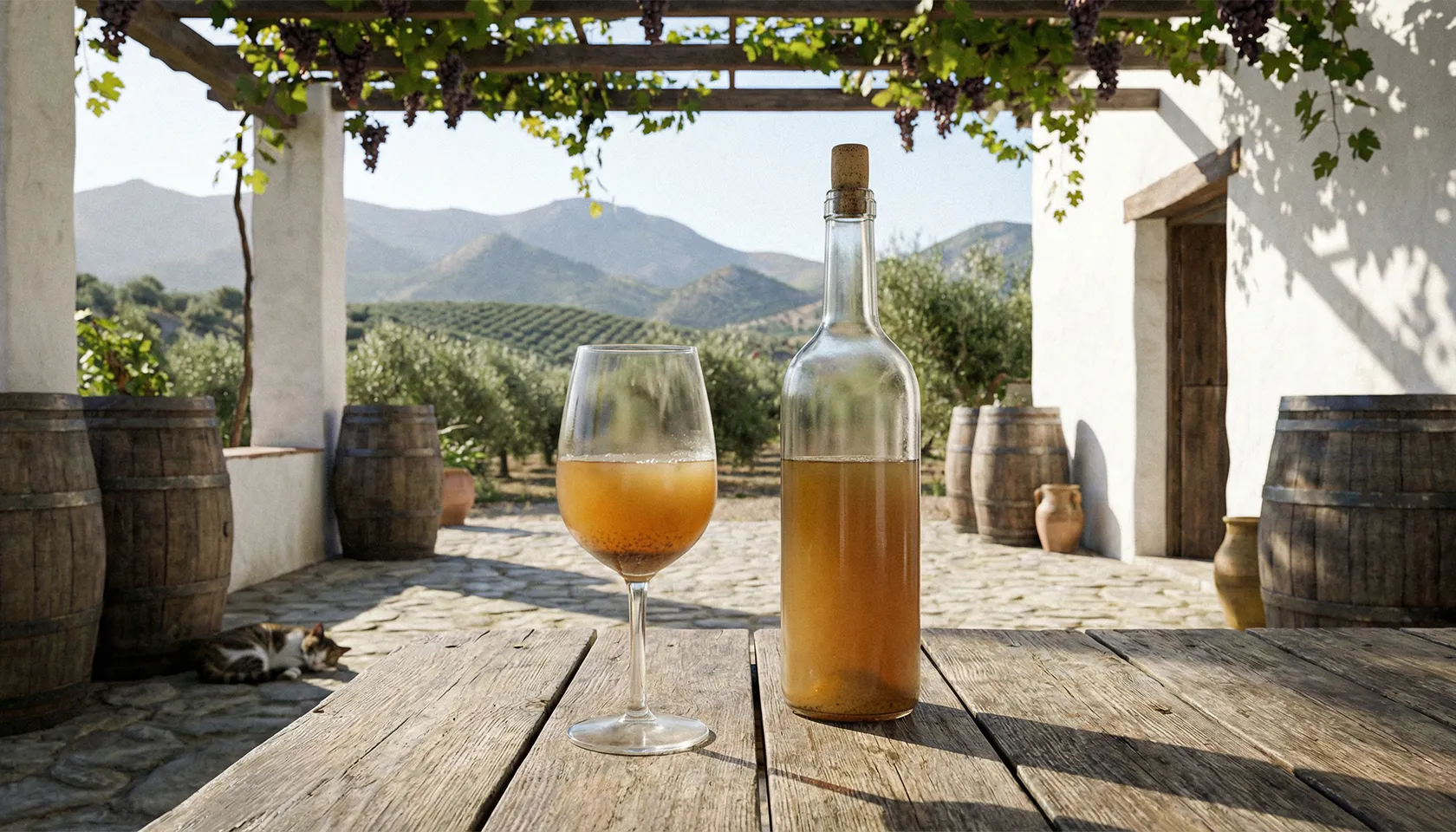
Is mosto grape juice or wine?
The word “mosto” technically means “must” in English — unfermented grape juice, fresh from the press, before fermentation has turned it into wine. That’s the textbook definition, and it’s accurate for most of northern Spain.
In La Rioja, in Basque pintxos bars, in most parts of Castile — if you ask for mosto, you’ll get a glass of cold, slightly sweet, non-alcoholic grape juice. It’s popular with kids, drivers, pregnant women, and anyone who wants to feel festive without the wine. The blogger Young Adventuress described it well from Logroño: a fresh, cloudy juice that looks a bit like apple juice. Perfectly pleasant. Zero degrees of alcohol.
But in Andalusia — particularly in Cádiz, Huelva, Seville, and Málaga — mosto means something else entirely.
Here, mosto is a young, freshly fermented wine. Cloudy, lively, seasonal, and very much alcoholic (around 9–12.5% ABV depending on the region). It’s made from grapes harvested in September or October, fermented for roughly 40 days, and ready to drink by late November. Locals call it vino niño — baby wine. It tastes of the grape variety in its most direct, unfiltered form: fruity, fresh, with a characteristic apple-like quality and a slight haze that tells you it hasn’t been processed within an inch of its life.
Think of the closest international equivalent: France’s Beaujolais Nouveau. Seasonal, young, released with celebration, not meant for the cellar. Except mosto is older, humbler, and far less commercially packaged.
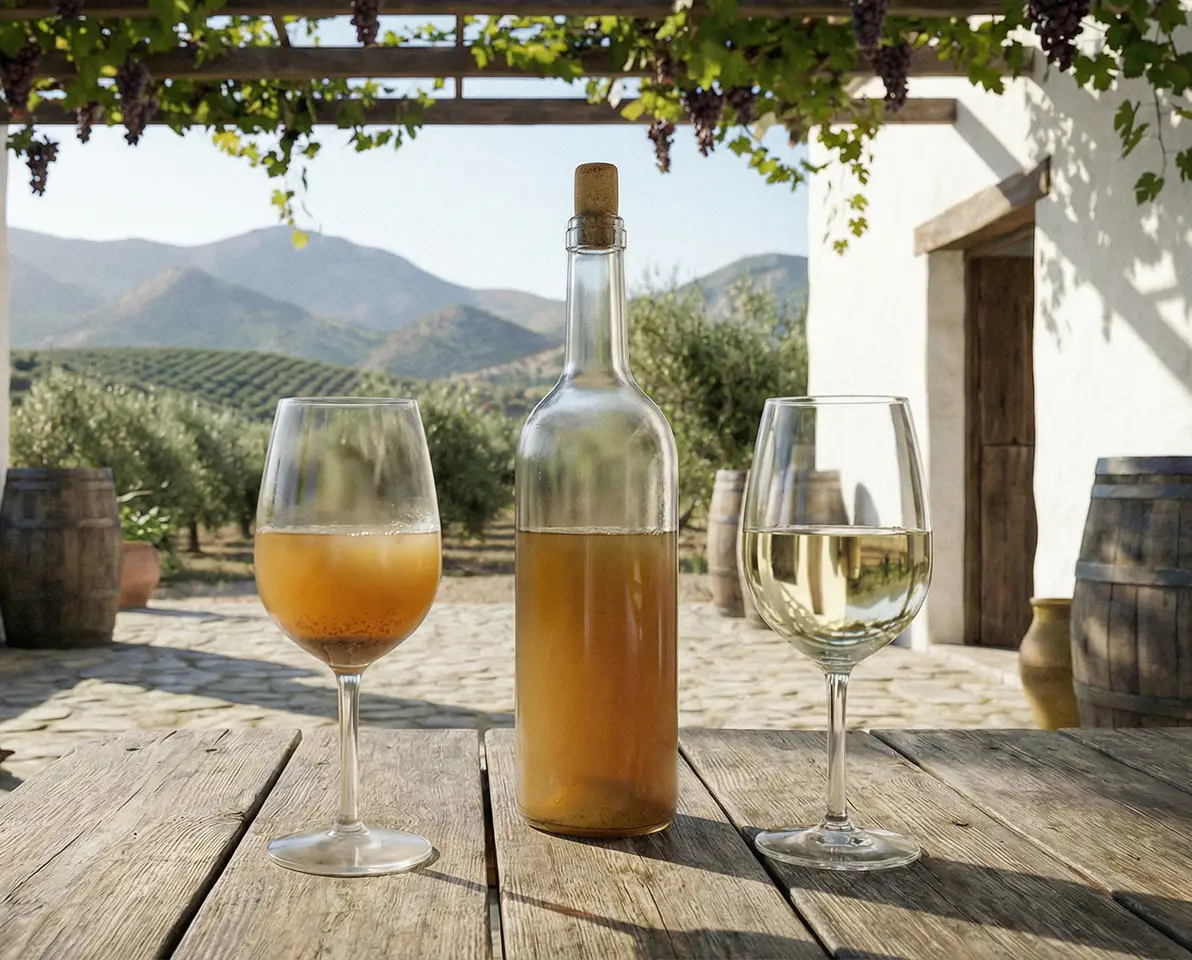
The confusion
The dual identity of mosto isn’t just a fun quirk — it catches people out constantly.
Most English-language travel writing about Spain describes mosto as a non-alcoholic grape juice drink. That’s fine if you’re writing about Logroño. But if you apply that description to Andalusia, you’re giving people incorrect information about whether what they’re drinking has alcohol in it. That’s a practical problem, not just a semantic one.
So here’s a quick summary before we go further:
| Where in Spain | What "mosto" means | Alcohol |
|---|---|---|
| Northern Spain | Unfermented grape juice | None |
| Jerez / Cádiz | Young fermented wine (Palomino grape) | ~11–12.5% |
| Aljarafe, Seville | Young fermented wine (Garrido/Palomino) | ~11.5% |
| Condado de Huelva | Young fermented wine (Zalema grape) | ~11% |
| Serranía de Ronda, Málaga | Young fermented wine (local traditional varieties) | ~9–12% |
Now you know. Order accordingly.
Mosto in the Serranía de Ronda: the version we love
We should be transparent here: we’re the Acinipo team, a wine blog rooted in the Ronda region. So yes, we’re a bit biased. But the local mosto tradition around here is genuinely something worth knowing about — not just because it’s delicious, but because it represents a continuous thread of winemaking that goes back thousands of years in this landscape.
The ancient Roman town whose name we borrowed — Acinipo — sat on a hilltop just outside Ronda and minted coins bearing grapevines in the 1st century BC. The name itself means City of Wine. People have been fermenting grapes in these mountains for a very long time, and the artisanal mosto tradition in the villages of the Valle del Genal is the most direct, living expression of that history.
Atajate: the village that's basically been doing this forever
To understand the local mosto culture, you need to know about Atajate.
It’s the smallest village in the entire province of Málaga — roughly 187 inhabitants, sitting at 745 metres above sea level, about 25 minutes from Ronda by car. It looks like a handful of whitewashed houses arranged around a small square, surrounded by terraced hillsides and the winding valleys of the Serranía. You could easily drive past it and not realise it was there.
But Atajate takes its mosto very seriously.
The village’s economy was built on viticulture from the 17th century onwards. At its peak in the 1800s, Atajate had over 30 active lagares (traditional winemaking facilities). Then phylloxera hit Málaga province in the 1870s — Spain’s first regional outbreak — and devastated the vines. Many families left. Commercial winemaking stopped. The ruins of those lagares are still visible in the hillsides today.
Some resistant vines survived, though. And families kept making their mosto through the whole disruption — in smaller quantities, with simpler equipment, but they kept doing it. That’s the thread that connects the village’s 18th-century prosperity to the festivals held there today.
The grape varieties still used are entirely traditional and largely unknown outside the village: Tempranillas (early-ripening, thick-skinned), Perrunas (small, tart, thin-skinned), De Rey (slightly sweeter), and Uvas de Loja (considered the finest for mosto). These are not the same grapes you’ll find in the region’s modern bodegas working under the DOP Sierras de Málaga. They’re pre-phylloxera heritage varieties, kept alive by the same families, generation to generation.
How the mosto is made
Grapes are harvested by hand in September and October. In Atajate, some families still foot-stomp the grapes in stone lagares — no romanticism here, it’s just the method that works for small quantities. The juice goes into wooden barrels called bocoyes (traditionally made of chestnut wood, which doesn’t impart flavour) or glass carboys called majuanas.
Fermentation takes around 40 days. There’s a local belief in Atajate that you should never rack the wine on a cloudy day — folk wisdom that’s been passed down alongside the more technical knowledge. Once the liquid is transferred off the sediment (a process called trasiego), it’s ready.
By late November, the mosto is drinkable.
The timing is not accidental. The Fiesta del Mosto de Atajate takes place on the last Saturday of November, every year.
Is mosto alcoholic?
In Andalusia, yes — typically around 9–12.5% ABV, similar to a light wine. In La Rioja and northern Spain, no — it’s grape juice with zero alcohol. Always worth asking where you are before assuming.
What does mosto taste like?
Fresh, fruity, and slightly cloudy. Most tasters notice a characteristic apple-like flavour alongside the grape variety’s natural character. It’s lighter and less complex than an aged wine, with lively acidity. Think of it as wine in its most direct, unfiltered form.
When can you drink mosto?
Mosto season runs from late November through February or March. The 40-day fermentation cycle means the new harvest’s mosto is ready around St Andrew’s Day (30 November) — which is why traditional festivals happen at the end of November.
Is mosto the same as wine?
Not technically. Mosto is wine in its youngest, least processed state — fermented, but not aged, blended, filtered, or stabilised. It’s consumed fresh within the same season it’s made. Once properly aged and processed, it becomes a conventional wine. Think of mosto as the beginning of the winemaking process, served before any of the refinement kicks in.
Sources: Ayuntamiento de Atajate — Fiesta del Mosto; Diputación de Málaga — Fiesta del Mosto de Atajate; Sherry Wine — The Must Season in the Marco de Jerez; Diario Ronda — Cartajima Cata de Mosto 2024; Universidad Pablo de Olavide — Vinos del Aljarafe: Mosto y algo más; Turismo del Aljarafe — El Mosto en el Aljarafe; Spanish Wine Collective — The Mosteros of Los Marines