A local guide of the best wineries in Ronda
This is not a list of the same five bodegas you’ll find on every travel blog. There are over twenty wineries in the Serranía de Ronda, and quite a few of them are spectacular.
Some have been producing wine since before the appellation existed. Some are recovering grape varieties that had been extinct for over a century. One is set inside a 16th-century convent. Another is literally next door to the Roman ruins that give this blog its name.
Which winery should you visit first?
Before the full breakdown, here’s the short answer for the most common situations:
- You’re staying in Ronda without a car → Descalzos Viejos (walking distance) or the Museo del Vino (town centre, no booking needed)
- You have a car and one afternoon → Bodega F. Schatz or Bodegas Lunares — both close to town, both excellent
- You want the best overall wine experience → Cortijo Los Aguilares or Bodega Doña Felisa
- You’re on a budget → Bodegas García Hidalgo (from €10)
- You want something nobody else has visited → Bodega Kieninger, Bodega Gonzalo Beltrán or Bodegas Morosanto
- You want to stay overnight at a winery → BadMan Wines / La Perla Blanca or Bodega Doña Felisa
The Wineries: Full guide
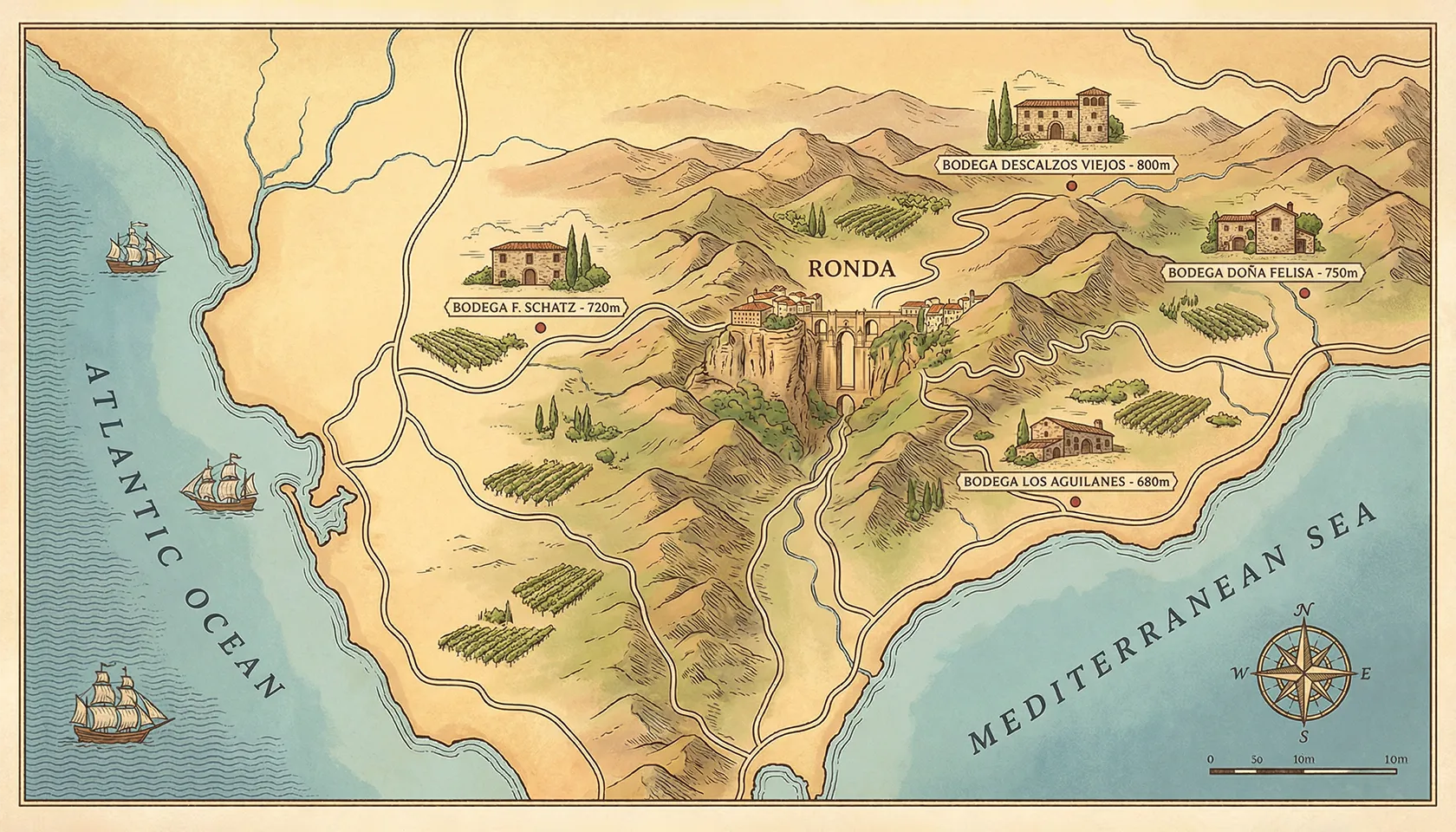
Descalzos Viejos — The convent on the cliff
The one you can walk to. Also one of the best.
In 1505, Queen Juana I of Castile granted a Trinitarian order the privilege of building a convent on the edge of the Tajo gorge. They did. In 1998, two architects — Paco Retamero and Flavio Salesi — bought the ruins, restored them, and planted vines. During the work they found 16th-century frescoes hidden under layers of lime. The barrel room is the old chapel. Those frescoes are still there.
The wines are serious: the DV+ (Graciano, Cabernet Sauvignon, Merlot) won Gold and then Great Gold at the Concours Mondial de Bruxelles in 2010 and 2011. The flagship DV Iusta — 100% Garnacha, only 2,000 bottles a year — is unlike anything else produced in this region. Their Syrah, the DV Rufina, is aged in barrels that previously held naturally sweet Axarquía wine; you can taste it.
Tours are personal and bespoke — usually led by Flavio or Paco themselves, or by their sommelier Vicente. This is not a ticketed group experience. You’ll have a proper conversation.
Practical info:
- Distance from Ronda: ~3 km — walkable or a short taxi
- Visit: ~1.5–3 hours. Price: ~€45–55/person
- Booking: By appointment only — contact direct (info@descalzosviejos.com / +34 607 167 482)
- Languages: English and Spanish
- Also hosts two music festivals per year (jazz and indie/electronic)
Bodega F. Schatz — Where it all started
The pioneer. Without this winery, the modern Ronda wine scene may not exist.
In 1982, an 18-year-old German named Friedrich Schatz arrived in Ronda with a plan. There was no appellation, no wine tradition, no modern viticulture. He’d studied topography and climate data across multiple countries and concluded this mountain landscape was ideal. He found a farmhouse called Finca Sanguijuela — the initials matched his own — and planted 3 hectares with nine varieties including Lemberger (Blaufränkisch) and Muskattrollinger, grapes virtually unheard of in southern Spain. He learnt Spanish from bricklayers. He became the first certified organic winemaker in Andalusia.
Forty years later, he still farms the same 3 hectares. He still makes just six wines — all biodynamic, all without added sulphites. One of them is called Acinipo. We take that as a good sign.
The estate produces around 15,000 bottles a year from a family tradition dating to 1641. You don’t come here for scale. You come here because this is where the story begins.
Practical info:
- Distance from Ronda: ~10 km north on MA-7402 (15 min drive)
- Visit: ~90 min. Price: from €35/person. Tasting of 4 wines with local products
- Booking: Advance booking required — no walk-ins (bodega@f-schatz.com / +34 952 871 313)
- Languages: English and Spanish
- Max group: 14–15 people
Cortijo Los Aguilares — The critical darling
Jancis Robinson’s Wine of the Week. Multiple golds at the world’s most prestigious Pinot Noir competition. A Grandes Pagos de España member. The estate doing the most serious viticulture in Ronda.
800 hectares at 900 metres — holm oaks, cereal fields, Ibérico pigs, and 25 hectares of organic, hand-harvested vines. The winery is gravity-fed; the Pinot Noir is possibly the most southerly serious example in Europe. The Tadeo Petit Verdot (100%, 15 months in French oak) and the Tadeo Tinaja (amphora-aged, around 1,400 bottles) are bottles people argue about in the good way.
Entry point is the Pago El Espino — a Petit Verdot, Syrah, and Tempranillo blend at around €20 that regularly scores 93–94 in Peñín. A bottle you can find and return to for years.
If you want to understand what Ronda’s altitude and limestone actually does to a wine — and not just read about it — a visit here is the best classroom available. Read our full profile of Cortijo Los Aguilares.
Practical info:
- Distance from Ronda: ~5 km (10 min drive) on the Ronda–Campillos road
- Visit options: Standard tasting from €35/person; also oenological hikes and seasonal picnics
- Hours: Mon–Fri 10:00–17:00 (book ahead)
- Booking: Required (+34 952 874 457)
- Languages: English, Spanish, French, Italian
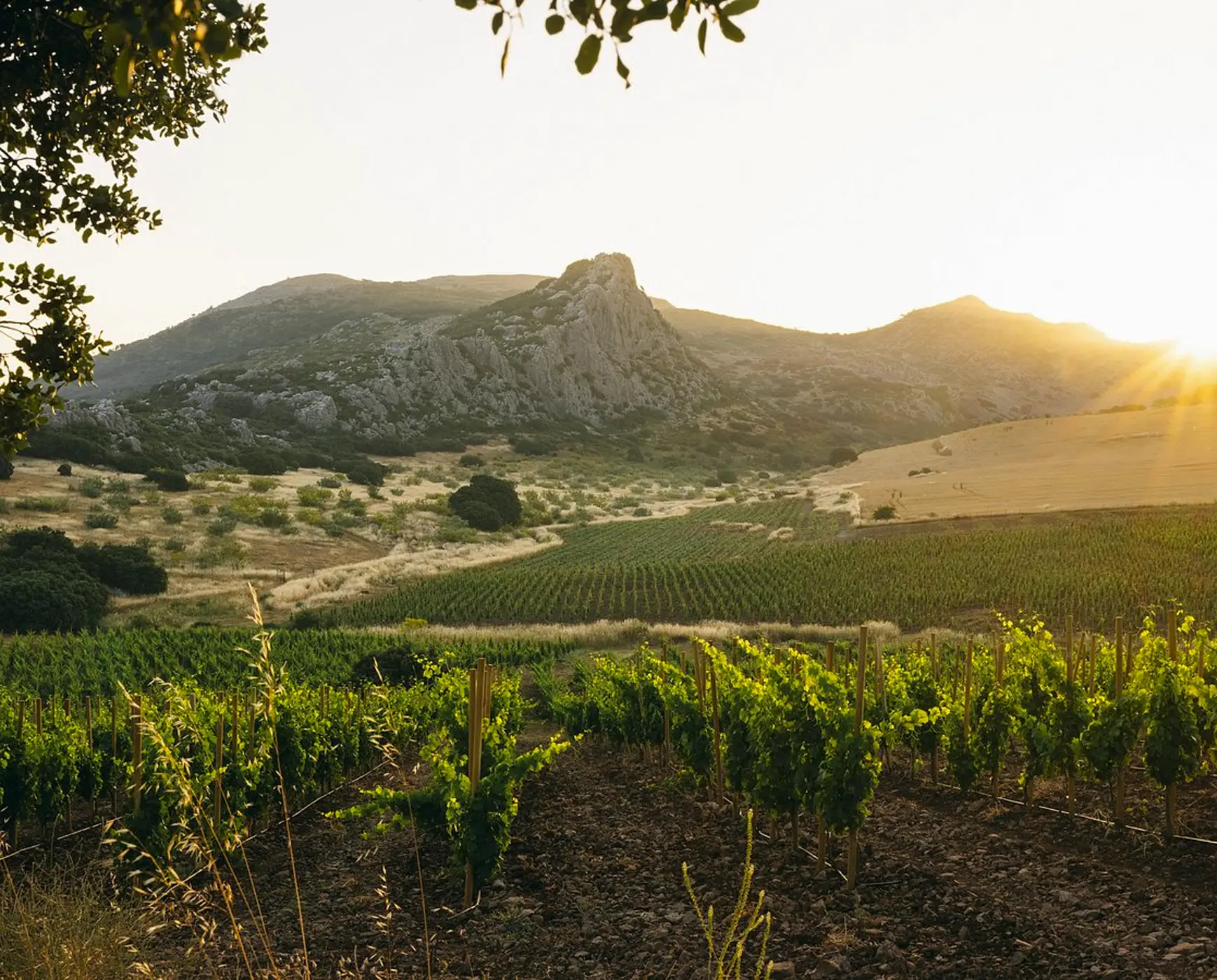
La Melonera — The story nobody else is telling
A winery dedicated to recovering grape varieties that nearly disappeared forever.
Before phylloxera wiped out Málaga’s vineyards in 1878, the Serranía de Ronda had nearly 13,500 hectares of vines and dozens of indigenous grape varieties — most of which simply ceased to exist. La Melonera, founded in 2003, has made bringing them back its central project. Working from an 1807 ampelographic survey of Andalusian varieties and in collaboration with the Rancho de la Merced research centre in Jerez, they’re cultivating Tintilla de Rota, Blasco, Romé, Melonera (the grape with melon-striped skin that names the estate), Perruna, and others. Varieties that haven’t been in commercial production for over a century.
The Payoya Negra — 50% Tintilla de Rota, 50% Blasco — won gold at the 39th Challenge International du Vin. It tastes like nothing else produced in Spain.
In 2008, the bodega hosted a symposium attended by Jancis Robinson, Michel Rolland, and Peter Sisseck. That visit put Ronda on the international wine map.
Read our full guide to La Melonera.
Practical info:
- Distance from Ronda: ~15 min drive (off the road to Acinipo)
- Visit: ~1.5–2 hours. Price: ~€43/person. Tour + tasting of 3–4 wines with local products
- Booking: Required (info@lamelonera.com / +34 951 194 018)
- Languages: English and Spanish
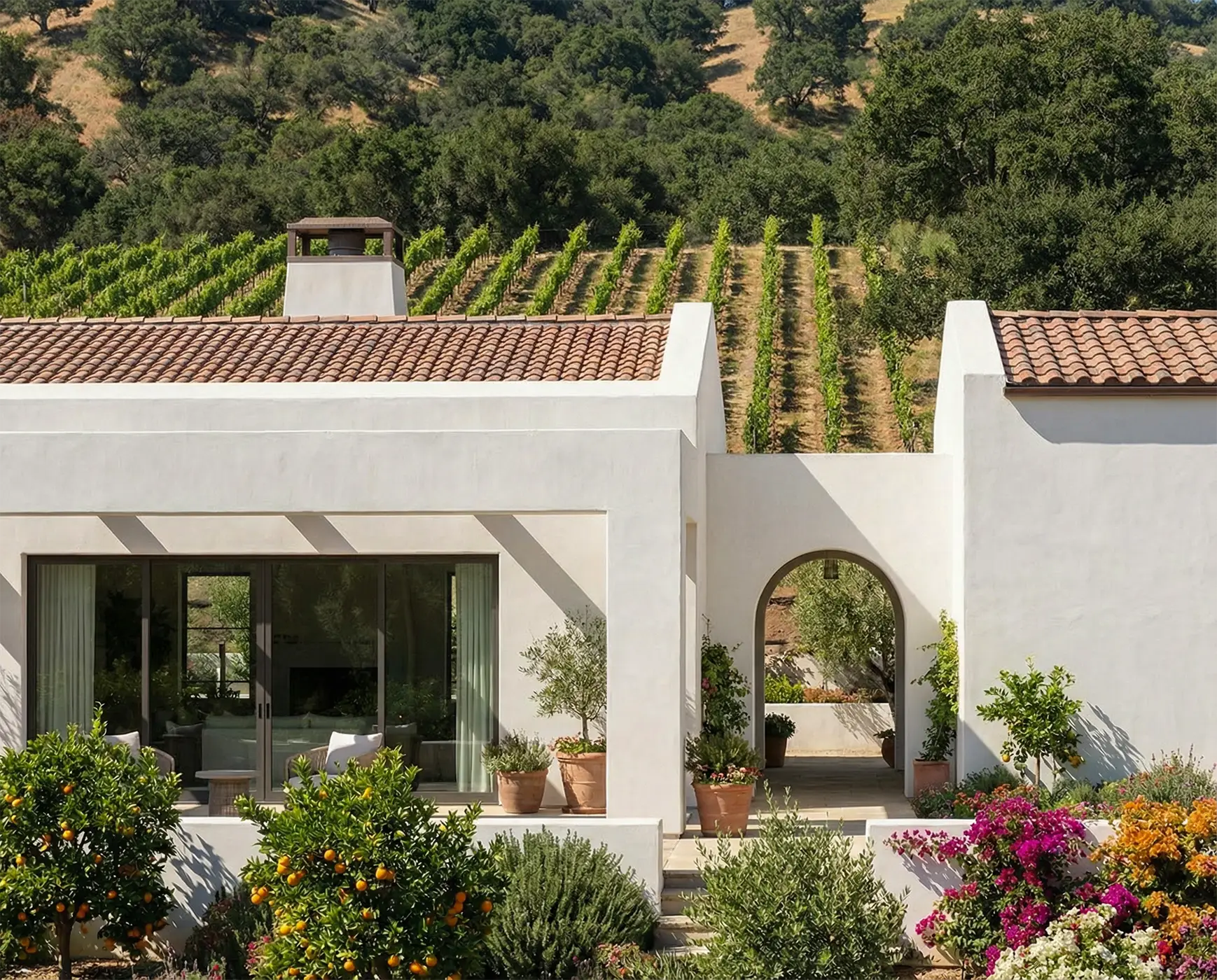
Bodega Doña Felisa (Chinchilla Wines) — Best all-round experience
The widest range of wines in Ronda. The warmest family welcome. The only bodega near Ronda where you can also sleep.
Founded in 1999 by José María Losantos — from Burgos, trained in Rioja — and his wife Gema. Named after José María’s mother-in-law. Now into the second generation, with a daughter who studied oenology and chemistry. The estate sits just below the Acinipo ruins, and José María has quietly assembled a small collection of Roman artefacts found on the property: coins with grape imagery, pottery fragments, arrowheads. Our kind of people.
The range spans ten wines: young reds, crianzas, a Champagne-method sparkling, a sweet Moscatel (100% Moscatel de Alejandría, only 2,000 bottles), and the Chinchilla Doble Doce Reserva (85% Cabernet Sauvignon), which won Best Cabernet Sauvignon in the World in Paris in both 2014 and 2016. Not 2014 or 2016. Both.
The château-style architecture looks slightly incongruous against the Andalusian landscape, but the experience is genuinely good — daily tours at 11:30, kids welcomed, overnight rooms available.
Practical info:
- Distance from Ronda: ~15–20 min drive north on MA-7402, near Acinipo
- Visit options:
- Tour + tasting + tapas: €38.50 (Spanish) / €43 (English) per person; children 12–17 €25; under 12 free
- Tour + wine-paired lunch: €79/person
- Overnight accommodation available
- Tours run daily at 11:30. Wheelchair accessible
- Booking: Recommended (enoturismo@bodegadonafelisa.com / +34 606 945 937)
- Languages: English and Spanish
Bodegas García Hidalgo — The Hidden Gem
The cheapest visit in Ronda. Also, consistently described as one of the best.
Miguel Ángel García and his wife Maribel run a 2-hectare family operation about 4–5 km from Ronda in the Guadalcobacín Valley. Two hectares. Husband and wife. Maribel’s homemade cooking — bread, red pepper jelly, paella — comes up in almost every review as the highlight of the visit.
The wine is honest and good. Their Zabel Cabernet Sauvignon has a 4.1 on Vivino. The basic visit (vineyard + winery + 3 wines) costs €10 per person. Not a typo.
This is the one to know about when someone tells you they don’t have a big budget or they’re not sure they’re “wine people.” You’ll leave converted.
Practical info:
- Distance from Ronda: ~4–5 km toward Arriate
- Visit options: from €10 (basic) / €18 (with tapas) / €30 (with food) / €125 (premium vertical + accommodation)
- Booking: Pre-arranged. Available most days by appointment (+34 670 940 693)
- Languages: Spanish primary; some English via website
Bodegas Lunares — One kilometre from town, open every day
The nearest serious bodega to Ronda’s centre. And one of the few that’s open seven days a week.
Just over 1 km from town on the road to El Burgo, Lunares has the practical advantage of being genuinely close — no full expedition required. Their highest vineyard, Finca Ronda La Vieja, sits at 1,000 metres near the Acinipo ruins and is the highest in the region. They’re also connected to Hotel Bodega El Juncal, so you can stay on-site.
The standout is Lunares para Bonus Track — 100% Perruna grape, made via a criaderas y soleras system, only 250 half-bottles produced per year. One of the rarest bottles in the province. Their Superluna (100% Graciano, 16 months in oak) is also exceptional.
Practical info:
- Distance from Ronda: ~1 km (road to El Burgo)
- Visit: ~90 min. From €30/person. 4 wines + cold appetiser
- Open every day of the year — one of the most flexible bodegas in Ronda
- Booking: Recommended (vinos@bodegaslunares.com / +34 649 690 847)
- Languages: English and Spanish
Bodegas Excelencia — Wine with a view of Ancient Rome
870 metres of altitude, a panoramic terrace, and a direct sightline to the Acinipo ruins. For us, this one has a particular pull.
Founded in 2006, Excelencia sits on the same ridge as the Roman city that gives this blog its name. Their semi-underground cellar goes 7 metres into the hillside; 150 French oak barrels in 600 square metres at naturally stable temperatures. The terrace — with wood-fired oven and space for up to 300 people — looks directly over the Acinipo ruins toward the Sierra de Grazalema.
The Tagus (100% Cabernet Franc, aged 18 months) is unusual for the region and worth seeking out. The Los Frontones blend is their reliable everyday bottle.
Practical info:
- Distance from Ronda: ~15–20 min north on the road toward Acinipo
- Visit: €30–36/person or €50 with pintxos. 1h 45m–2h 45m
- Mon–Sat by appointment (ronda@bodegasexcelencia.com / +34 628 115 561)
- Languages: English and Spanish
BadMan Wines / La Perla Blanca — Stay the Night at a Bodega
The youngest serious producer in Ronda. A 7-room B&B. And a rare grape called Golfus.
BadMan was founded in 2016 by Simbad Romero and Manuel Carrizosa — two friends from Seville who spent eight years studying winemaking across Italy, Argentina, France, the US, Australia, New Zealand, and South Africa before coming back to Ronda. The name combines “SimBAD” and “MANuel,” which is either very good or very bad branding depending on your perspective. The wine is very good.
Their Tempranillo — aged in ovoid concrete tanks, no wood, no filters — is particularly clean. They also grow Golfus, an extremely rare indigenous variety that appears in almost no other bodega in Spain. The B&B (Julian and Jodie, English-speaking management, pool) means you can turn a visit into an overnight without moving hotels.
Practical info:
- Distance from Ronda: ~8 km (~10 min drive)
- Visit: Daily by appointment. Vineyard + bodega + 4–5 wines + local products. ~€30–43/person (estimated)
- Stay: 7 rooms, pool, B&B rates at la-perlablanca.com
- Booking: Tours via Milamores Ronda (gema@milamoresronda.com / +34 656 543 343)
- Languages: English — management is native speakers
Bodega Joaquín Fernández — Over 7,000 visitors a year for a reason
The most visited small bodega in Ronda. Known for their “white wine from red grapes” and beeswax-sealed bottles.
Finca Los Frutales, 3 km from Ronda. Lavender planted between vine rows. Their Blanco de Uva Tinta — a white wine made from red grapes via careful skin separation — is the kind of conversation-starter that works well. Bottles sealed with beeswax rather than capsules. Wildly instagrammable, for what that’s worth.
Consistently well reviewed, especially for groups. One of the most accessible, friendly introductions to Ronda wine.
Practical info:
- Distance from Ronda: ~3 km
- Booking: +34 951 166 043
- Languages: English and Spanish
Bodega Gonzalo Beltrán — Organic, walkable, underrated
Directly below the Tajo gorge. One of the few bodegas you can reach on foot from Ronda’s centre (~30 minutes downhill).
Organic and biodynamic. Their Perezoso (100% Syrah) is the headline wine; their Resilencia Viognier white is one of the more unusual bottles in the region. Intimate, personal visits — this is a micro-winery with genuine character.
Practical info:
- Distance from Ronda: Walkable (~30 min) or short taxi
- Visit: ~90 min. €30/person
- Booking: bodegagonzalobeltran.com / +34 629 455 558
Bodega Kieninger — The austrian connection
The only winery in Spain growing Blaufränkisch, Blauburgunder, and Zweigelt as standard varieties. Founded by an Austrian architect.
Martin Kieninger arrived in Ronda, fell in love with the landscape, and planted the varieties he grew up with. The result is genuinely singular — you won’t find a Zweigelt in any other Andalusian bodega. 100% ecological, 2.5 hectares, strictly personal visits. Martin guides in Spanish, English, and German.
Practical info:
- Location: MA-7402 north of Ronda
- Visit: €50 for up to 4 people, then €12/person additional
- Booking: bodegakieninger.com / +34 618 685 152
Bodega Huerto de la Condesa — If you have no car
Located on Ronda’s industrial estate, which sounds unglamorous until you realise they also have a vineyard where you can do the tasting instead.
Huerto de la Condesa is the answer to one of the most common questions we get: is there a working winery I can actually reach on foot from Ronda? This one is it. The bodega itself is in the polígono industrial — a short, easy walk from the centre — but they offer the option of doing the visit and tasting at the vineyard instead, which is a considerably more scenic proposition.
It’s a genuine bodega producing proper DO Sierras de Málaga wines, not a museum or a bar with a wine list. If you’ve arrived without a car and want to visit a working winery rather than just drink by the glass in town, this is your best bet.
Practical info:
- Location: Polígono Industrial de Ronda — walkable from town centre
- Tasting options: At the bodega or at the vineyard (confirm preference when booking)
- Booking: Contact the bodega directly for current pricing and availability
Other Bodegas worth knowing about
A few more names for the curious:
Bodegas Morosanto — Has a Roman lagar (ancient stone wine press) on site with archaeology included in the tour. Unusual and genuinely interesting (+34 662 671 111).
Bodega Pasos Largos — Named after a famous 19th-century bandit from the Serranía. Set in an 18th-century cortijo. The romanticism is earned (+34 673 235 072).
Bodega Vetas — Possibly the smallest bodega in Andalusia. Around 1 hectare, founded 1998, one of the earliest producers. Their Petit Verdot is acclaimed and the production is extremely limited (bodegavetas.com).
Samsara Wines — Located directly in front of the Puente Nuevo. For when you want a glass within sight of the bridge.
How to plan your visit
You have a car
Most bodegas cluster north of Ronda along the MA-7402 toward Acinipo — Schatz, Doña Felisa, Excelencia, and La Melonera are all within a 20-minute drive of each other. A half-day circuit visiting two or three bodegas is entirely doable.
Suggested half-day route (morning):
- Bodegas Excelencia (10:00) — start with the Acinipo views
- Bodega Doña Felisa (12:00) — catch the daily 11:30 tour, or book your own slot
Suggested full-day route:
- Cortijo Los Aguilares (10:00)
- Bodega F. Schatz (12:30)
- Lunch in Ronda town
- Descalzos Viejos (late afternoon, by appointment)
You don't have a car
Your walkable options: Descalzos Viejos (~3 km from centre, manageable walk), Bodega Gonzalo Beltrán (~30 min downhill), and Bodega Huerto de la Condesa (polígono industrial, walkable — ask to do the tasting at the vineyard).
For everything else, you have two good options:
- Taxi: €10–20 each way to most bodegas. Worth it for a single visit.
- Organised tour: Several operators run day trips from Ronda, Málaga, and Marbella with transport included.
Price comparison table
| Bodega | Visit price | What's Included | Booking |
|---|---|---|---|
| Huerto de la Condesa | From €30 | Tasting at bodega or vineyard | Contact direct |
| García Hidalgo | From €10 | Vineyard, winery, 3 wines | By appointment |
| Descalzos Viejos | ~€50 | Full bespoke visit, 1–3 hrs | Appointment only |
| F. Schatz | From €35 | Vineyard, cellar, 4 wines, appetiser | Advance booking required |
| Cortijo Los Aguilares | From €35 | Vineyard, winery, tasting | Mon–Fri, book ahead |
| Lunares | From €30 | 90 min, 4 wines + appetiser | Recommended; open daily |
| Bodegas Excelencia | €30–50 | 1h 45m–2h 45m + pintxos option | Mon–Sat, appointment |
| BadMan Wines | ~€40 | Vineyard, bodega, 4–5 wines | By appointment |
| Doña Felisa | ~€40 | 1.5 hrs, 4 wines + tapas | Daily 11:30, pre-book |
| La Melonera | ~€43 | 1.5–2 hrs, 3–4 wines + products | Appointment |
| Gonzalo Beltrán | €30 | 90 min tasting | Appointment |
| Kieninger | €50 | Private visit | Appointment |
How much does a winery visit in Ronda cost?
Most winery visits in Ronda cost between €30 and €50 per person, typically including a vineyard walk, cellar tour, and tasting of 4–5 wines with local tapas. The cheapest serious option is Bodegas García Hidalgo from €10. Organised day tours from Málaga or Marbella with transport run €100–180 per person.
What wines does Ronda produce?
Ronda specialises in full-bodied red wines, with Petit Verdot as the standout variety — it thrives here in ways it can’t manage in Bordeaux. Syrah, Cabernet Sauvignon, Tempranillo, Garnacha, and Pinot Noir are all widely grown. Whites account for around 20% of production: mostly Sauvignon Blanc, Chardonnay, and Viognier. Several bodegas are also reviving pre-phylloxera indigenous varieties — Tintilla de Rota, Blasco, Melonera, Perruna — that were lost for over a century. There’s also one traditional-method sparkling wine (Bodega Doña Felisa) and various sweet wines.
What is the best time of year to visit Ronda wineries?
September during the harvest (vendimia) is ideal — you may be able to join the picking, and the vineyards are at their most photogenic. April to May is also excellent: mild temperatures, green countryside, fewer visitors. Avoid July and August if possible. Winter is underrated — cold, quiet, and the winemakers are far more available.
How many wineries are there in Ronda?
The Serranía de Ronda has approximately 20–23 active wineries, of which around 16–18 welcome visitors by appointment. The broader DO Sierras de Málaga covers around 40–45 producers across Málaga province. Modern winemaking in Ronda only began in 1982 when Friedrich Schatz planted the first vines; the DO was established in 2001.
What is the DO Sierras de Málaga?
DO Sierras de Málaga is the Denomination of Origin covering dry still wines in Málaga province — whites, rosés, and reds. It was established in 2001, specifically to accommodate the new wave of mountain winemakers who had nothing in common with the traditional sweet Málaga wines. The Serranía de Ronda is the only formally recognised subzone within it, with stricter rules: 100% local grapes, hand-harvested in small boxes, vinified by bodegas within the subzone. It’s governed by the same Consejo Regulador as DO Málaga (sweet wines) but the two DOs produce entirely different products.
Sources: Consejo Regulador DO Sierras de Málaga, Guía Peñín, Concours Mondial de Bruxelles, Mondial des Pinots de Sierre competition records, International Cabernet Competition Paris records, direct bodega information.