Ronda wines
Forget everything you think you know about Andalusian wine. Ronda is different.
We named our project after a coin. A small bronze coin, minted sometime around 47 BCE, that shows a bunch of grapes on one side and two ears of wheat on the other. It was struck right here, at Acinipo — the Roman city that stood 20 kilometres north-west of modern Ronda, at 999 metres above sea level. That coin was basically the ancient world’s version of a regional brand: this is what we grow, this is what we’re proud of.
Two thousand years later, the grapes are back. And they’re producing some of the most unexpectedly brilliant wines in Spain.
We know this region better than most. We live here, we drink here, we’ve spent years poking around in the history of this land. And we genuinely believe Ronda is one of the most underrated wine stories in Europe. This guide is our attempt to explain why — and to give you everything you need to explore it properly, whether you’re planning a visit, hunting down a bottle, or just curious about what makes a Serranía de Ronda red different from everything else in Andalusia.
Wait — is "Ronda wine" actually a thing?
It is, and it’s better than you probably expect.
Here’s the thing most people get wrong: they hear “Andalusia,” they think sweet, fortified, sun-baked wine. They think Sherry, or that thick, sticky Málaga moscatel you get as a digestif in a restaurant. That’s a perfectly fine wine — but it has nothing to do with what we’re talking about.
Ronda sits at 700 to 1,000 metres in the mountains of Málaga province, where Atlantic and Mediterranean winds collide over ancient limestone. The average annual temperature hovers around 14.7°C. Vineyards experience temperature swings of 15–25°C between day and night during the growing season. The Peñín Guide — Spain’s equivalent of the Wine Spectator — has compared the soils here to Priorat’s, except chalky rather than slatey. The Financial Times wine critic has written about the region. Pinot Noir thrives here in ways that would make a Burgundy producer raise an eyebrow.
This is not sweet-wine country. This is mountain wine country. And the altitude changes everything.
First things first: Ronda wine is not Málaga wine
Before we go further, let’s clear up a confusion that trips up even wine-savvy visitors.
The province of Málaga has two separate Denominations of Origin, both governed by the same regulatory body:
- D.O. Málaga (established 1932) covers the sweet wines — Pedro Ximénez, Moscatel, fortified, vinos de licor. This is the historic appellation, the legendary “Mountain Wine” that Catherine II of Russia exempted from import duties in 1791. Genuinely lovely stuff, but not what we’re talking about.
- D.O. Sierras de Málaga (established 2001) covers dry still wines — whites, rosés, and reds — with alcohol between 10% and 15.5%. It was created specifically for the new wave of producers around Ronda who were planting Petit Verdot, Pinot Noir, and indigenous varieties, and making modern, terroir-driven table wines that had absolutely nothing in common with sweet Málaga. Within this D.O., the Serranía de Ronda is the only formally recognised subzone, with its own stricter rules: 100% of grapes must come from within the subzone, harvested by hand in small boxes, and vinified by bodegas located inside it.
So when someone tells you Ronda wine is just “Málaga wine” — politely correct them.
What makes the terroir special: altitude, two seas, and ancient limestone
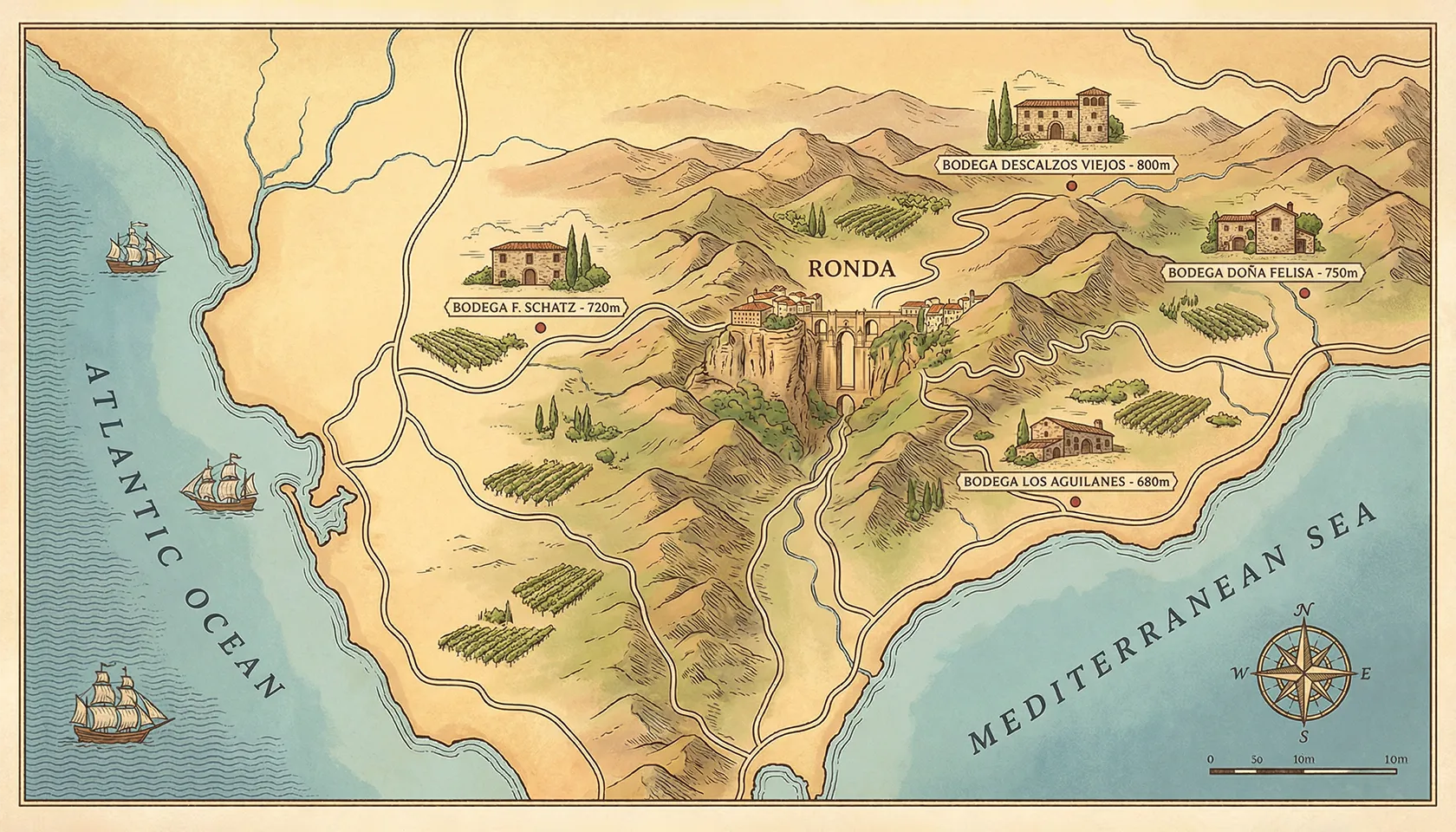
Ronda’s wines are shaped by three things working together, and understanding them is the key to understanding why these bottles taste the way they do.
Altitude:
Vineyards here sit at 700–1,000 metres — comparable to Ribera del Duero, but in Andalusia, at latitude 36.7°N. For every 100 metres of elevation, temperatures drop roughly 1°C. A vineyard at 900 metres (like Cortijo Los Aguilares or Bodega Doña Felisa) is effectively several degrees cooler than the coast 60 kilometres to the south. Hot enough during the day to ripen grapes fully. Cool enough at night to preserve the acidity, the aromatics, the freshness that most Andalusian wines simply don’t have.
Two oceans at once:
The Serranía de Ronda sits in a remarkable geographic position straddling the Atlantic and Mediterranean watersheds. The Sierra de Grazalema immediately to the west captures Atlantic air masses and generates more than 2,000mm of annual rainfall — the highest in the entire Iberian Peninsula. Those moisture-laden westerly winds funnel through mountain gaps towards Ronda. Meanwhile, the Mediterranean lies 60 kilometres to the south, delivering warmer air that moderates winters and contributes to 2,700–3,000 hours of annual sunshine. The result: Ronda gets around 725–817mm of rain per year (far more than most of Andalusia) plus intense summer sunshine for ripening. You get both structure and fruit.
Limestone:
The Ronda Depression sits in an intermontane basin filled with clays, dolomites, limestones, and marl eroded from surrounding marine limestone mountains over five to eleven million years. These calcareous soils retain moisture through bone-dry summers, drain well in wet winters, and critically — they push natural acidity in the grapes. The Peñín Guide has explicitly compared them to Priorat’s soils. Same principle. Different expression.
The net result is something quite unusual: wines that combine the fruit density you’d expect from southern Spain with the freshness and structure you’d expect from regions hundreds of kilometres further north. Full ripeness. Genuine acidity. Mineral backbone. A bottle that actually gets more interesting as it warms in your glass.
The grapes: what grows here and why it matters
| Variety | Type | Style |
|---|---|---|
| Petit Verdot | Red | Full-bodied, dark fruit, violet, graphite |
| Pinot Noir | Red | Elegant, silky, red cherry, forest floor |
| Syrah | Red | Spicy, savoury, black pepper, dark plum |
| Cabernet Franc | Red | Herbaceous, cassis, pencil shavings |
| Tintilla de Rota | Red (native) | Tart, earthy, sour cherry, mountain herbs |
| Sauvignon Blanc | White | Crisp, citrus, mineral, fresh acidity |
| Chardonnay | White | Stone fruit, toasted hazelnut, creamy but fresh |
| Moscatel Morisco & Doradilla | White (native) | Floral, orange blossom, dried apricot, delicate |
Petit Verdot: Bordeaux's problem child, Ronda's star
In Bordeaux, Petit Verdot is the difficult one. It buds early, ripens late, and in the cool, damp Left Bank climate it rarely achieves full maturity — hence its name, “the small green one.” It ends up as a tiny percentage of blends, added for colour and tannin when conditions allow.
In Ronda, it’s the flagship variety.
Oenologist Juan Manuel Vetas planted it here in 1991 — these are some of the oldest Petit Verdot vines in Spain. What he understood, and what subsequent winemakers have confirmed, is that Ronda gives this variety exactly what Bordeaux cannot: a long, hot growing season to ripen fully, plus those cool nights to keep it fresh. The result, in the words of winemaker Bibi García of Cortijo Los Aguilares, is the opposite problem from Bordeaux: “the challenge is to rein in its natural concentration and structure.” As Elena García Sánchez of the same estate put it, Petit Verdot “is not an autochthonous variety but has become one that seems to belong.”
Wines to seek out: Cortijo Los Aguilares Tadeo, Bodega Vetas, and F. Schatz’s biodynamic 100% Petit Verdot. For a full breakdown of styles, producers, and how to buy them, see our guide to Ronda red wine.
Pinot Noir at the edge of possibility
Cortijo Los Aguilares grows what is almost certainly one of the most southerly serious Pinot Noirs in Europe — 6 hectares at 900 metres, planted in 1999. The estate was founded by a Burgundy devotee and is now led by winemaker Bibi García, who trained in Burgundy and Priorat.
Growing Pinot at latitude 36.7°N requires specific interventions. García deliberately arranges the leaf canopy to shade the bunches — at altitude, radiation is extreme and Pinot’s delicate skin risks scorching. Harvesting happens in two passes: an early pick for acidity, then a second two weeks later for ripe fruit. Cold maceration, controlled fermentation, ageing in used French oak and concrete eggs.
The result: a Pinot that has won Grand Gold at the Mondial des Pinots de Sierre (2008) and Gold twice more (2010, 2018) — the only Spanish Pinot Noir to win multiple golds at the world’s most prestigious Pinot competition. Guía Peñín scores reach 90–94 points consistently.
Native varieties: the most important story nobody is telling
This is where it gets genuinely exciting, and where almost nobody in the wine press is paying enough attention.
Before phylloxera devastated Málaga province in 1878 — one of the first areas infected in all of Spain — the Serranía de Ronda had 13,494 hectares of vineyards. They were wiped out over the following decades. Countless indigenous grape varieties were permanently lost. Vineyards were replanted with olive groves and pine forests. Wine essentially vanished from Ronda for approximately 100 years.
La Melonera, founded in 2003 just 2 kilometres from the Acinipo ruins, has made the systematic recovery of these lost varieties its central project. Working from Simón de Rojas Clemente’s 1806 ampelographic survey of Andalusian varieties and using cuttings from the Rancho de la Merced research centre in Jerez, they’re bringing back grapes that haven’t been commercially produced in over a century:
- Tintilla de Rota — native to the coastal town of Rota, documented since the 17th century, exported to England as “Tent” wine, nearly wiped out when a Spanish-American military base was built in the 1950s. Only about 17 hectares survive in all of Andalusia. La Melonera uses it in their Payoya Negra blend, which won gold at the 39th Challenge International du Vin.
- Blasco — ancient Andalusian red, recovered from near extinction.
- Romé — the only truly autochthonous red authorised under both Málaga D.O.s. Some vines in the Axarquía are 125 years old and survived phylloxera.
- Melonera — the grape that gives the bodega its name, with distinctively striped skin resembling a melon.
Other producers are also pushing in unusual directions. F. Schatz — the German pioneer who started all of this in 1982 — grows Lemberger (Blaufränkisch) and Muskattrollinger, varieties virtually unique to southern Spain. Bodega Kieninger, founded by an Austrian architect, grows Blaufränkisch and Zweigelt alongside Spanish varieties.
Whites
White wines account for roughly 20% of production but tend to sell out faster than reds. Ronda whites lean towards fresh, aromatic styles with citrus and mineral notes — the altitude does the same work here as it does for the reds. Bodega Doña Felisa produces the region’s only traditional-method sparkling wine: Cloe Brut Nature, 100% Sauvignon Blanc, 14–18 months on lees, at around €25. Worth seeking out.
The bodegas: how to read the region through its producers
There are around twenty active wineries (bodegas) in the Serranía de Ronda. They don’t have a uniform identity. What they share is altitude, limestone, and the particular ambition that comes from building a wine region from scratch in a place where, forty years ago, there wasn’t one.
Planning a visit? The logistics — which wineries to prioritise, what each visit costs, how to get there without a car, and the best time of year — are all in our dedicated guide to the best wineries in Ronda.
Where to drink Ronda wine in town
Not everyone has a car or time for a full winery visit. The good news: the town centre has a handful of places that take local wines seriously — and a glass of Ronda Petit Verdot in the afternoon, sitting above the Tajo, is not a bad use of your time.
Entre Vinos (Calle Comandante Salvador Carrasco) is the starting point. Over 100 wines available, many by the glass from around €2–3, tapas from €1.50. Small, knowledgeable, genuinely focused on the Serranía. If you want to work through several local producers without committing to a full visit, this is where you do it.
Pura Cepa (inside the Hotel Palacio de Hemingway) takes a broader approach — a well-curated list that spans Spanish regions, with a good local section. Food pairing is taken more seriously here than at most wine bars in town.
Tabanco Los Arcos for something more atmospheric — an old-fashioned tabanco-style bar with a rotating selection of local wines by the glass.
Bardal (2 Michelin stars, Calle José Aparicio 1) is the serious option. Chef Benito Gómez’s wine list is exceptional and specifically built around the wines of the Serranía de Ronda — this is where you spend money on a bottle you’ll remember.
What to eat with Ronda wine
The food of the Serranía mirrors the landscape: cured meats, game, mountain cheese, wild mushrooms. The pairings are direct.
Rabo de toro (Ronda’s signature oxtail stew, slow-cooked in red wine and vegetables) with structured, oak-aged reds — Descalzos Viejos DV+, Cortijo Los Aguilares Pago El Espino, or Chinchilla Doble Doce.
Queso Payoyo — award-winning artisanal cheese from Payoya goats native to the Sierra de Grazalema, multiple World Cheese Award winner. Semi-cured versions with young dry whites; cured wheels with young Tempranillo or Garnacha. And La Melonera’s Payoya Negra — literally named after the goat breed — makes a symbolic and genuinely complementary pairing: the Tintilla-based acidity cuts right through the fat.
Game meats — venison (venado), wild boar (jabalí), partridge (perdiz) — demand the most structured reds. Tadeo Petit Verdot, F. Schatz Acinipo (biodynamic Lemberger), and Payoya Negra are all specifically recommended for game by local sommeliers.
Wild mushrooms from the Serranía with Cortijo Los Aguilares Pinot Noir. Not a difficult sell.
Ibérico pork from free-ranging black pigs — the same holm-oak forests where Cortijo Los Aguilares raises their pigs, on the same estate as their vines. The circularity is pleasing.
From Acinipo's coins to Friedrich Schatz's suitcase
We’ll keep this tight because you can read the long version elsewhere on this site, but context matters.
The archaeological site of Acinipo — our site, our namesake — sits at 999 metres, 20km from modern Ronda. In the 1st century BCE, it minted bronze coins with a grape cluster on one face and wheat on the other. Numismatist Bartolomé Mora Serrano has documented these in detail; one example resides in the British Museum. The name Acinipo itself carries two competing etymologies: “city of the inhabitants of the peak” in Tartessian, reinterpreted by the Romans through Latin acinus (grape berry) as “Land of Wines.” Both meanings may be accurate. It was a hilltop city that grew grapes.
Phoenician traders had been in the region since at least 1100 BCE. By the 18th century, Málaga’s sweet Mountain Wine was among the most celebrated in Europe. Then phylloxera struck in 1878 — one of the first regions infected in Spain. Before it, the province had 112,000 hectares of vineyards, of which 13,494 were in the Serranía de Ronda. Afterwards: olive groves and pine forests. Wine essentially vanished for approximately 100 years.
Then, in 1982, an 18-year-old German arrived with a suitcase and a plan. Friedrich Schatz planted 3 hectares at 700 metres. He proved the terroir worked. Others followed. By 2001, the D.O. Sierras de Málaga existed. Today, roughly 30 bodegas produce around 1 million bottles from 300 hectares. The 18-year-old is still here, still farming biodynamically. The coin is still in the British Museum. And the wines are better than they’ve ever been.
Is Ronda wine good?
Yes, and notably so. Ronda’s high-altitude terroir (700–1,000 metres) combined with dual Atlantic-Mediterranean influence produces wines with genuine freshness and structure that are rare in southern Spain. Cortijo Los Aguilares has won multiple golds at the world’s most prestigious Pinot Noir competition; Bodega Doña Felisa’s Cabernet Sauvignon won Best in the World in Paris twice (2014 and 2016); Descalzos Viejos has won Great Gold at the Concours Mondial de Bruxelles. The Guía Peñín regularly scores top bottles at 90–94 points. It’s good.
What wine is Ronda known for?
Petit Verdot is the signature variety — a grape that struggles in Bordeaux but finds its ideal conditions here. Ronda also produces serious Pinot Noir (unusual this far south), Syrah, Cabernet Franc, and a growing range of indigenous pre-phylloxera varieties like Tintilla de Rota and Blasco. Whites account for about 20% of production and are mostly Sauvignon Blanc, Chardonnay, and aromatic blends.
What's the difference between Ronda wine and Málaga wine?
They’re separate Denominations of Origin, though governed by the same regulatory body. D.O. Málaga covers sweet and fortified wines (Pedro Ximénez, Moscatel). D.O. Sierras de Málaga — which includes the Ronda subzone — covers dry still wines: whites, rosés, and reds. Very different products, very different traditions.
Where can I drink Ronda wine in the town centre?
Entre Vinos (Calle Comandante Salvador Carrasco) is the best starting point — over 100 wines, many by the glass from €2–3, tapas from €1.50. 15 Arroba and Tabanco Los Arcos are also worth visiting. The Museo del Vino has a wine shop with local bottles if you want to take something home. Bardal (2 Michelin stars) is the special occasion choice.
Is Ronda wine available outside Spain?
Selected producers export to the UK and EU. Cortijo Los Aguilares is available through UK specialist importers including Indigo Wine and Roberson Wine. F. Schatz and Descalzos Viejos appear sporadically in specialist Spanish wine retailers. Within Spain, most bodegas sell direct from the estate and via their own online shops. Stock is limited — production volumes across the whole region are around one million bottles a year.
How does Ronda wine compare to Rioja?
Different in almost every respect. Rioja is primarily Tempranillo-based, with a long tradition of extended oak ageing and a well-established export market. Ronda leans on Petit Verdot, Syrah, and international varieties alongside indigenous grapes being recovered from near-extinction. The altitude (700–1,000 metres) gives Ronda wines more freshness and mineral acidity than most southern Spanish reds. Where a Rioja Reserva is reliable and structured, a Ronda red tends to be more individual — sometimes more ambitious, sometimes more unusual. The price points are broadly comparable for equivalent quality levels.
Sources: Guía Peñín, Consejo Regulador D.O. Sierras de Málaga, Bartolomé Mora Serrano (numismatic research on Acinipo coinage), Rancho de la Merced research centre (Jerez), Mondial des Pinots de Sierre competition records, Concours Mondial de Bruxelles records, International Cabernet Competition Paris records.