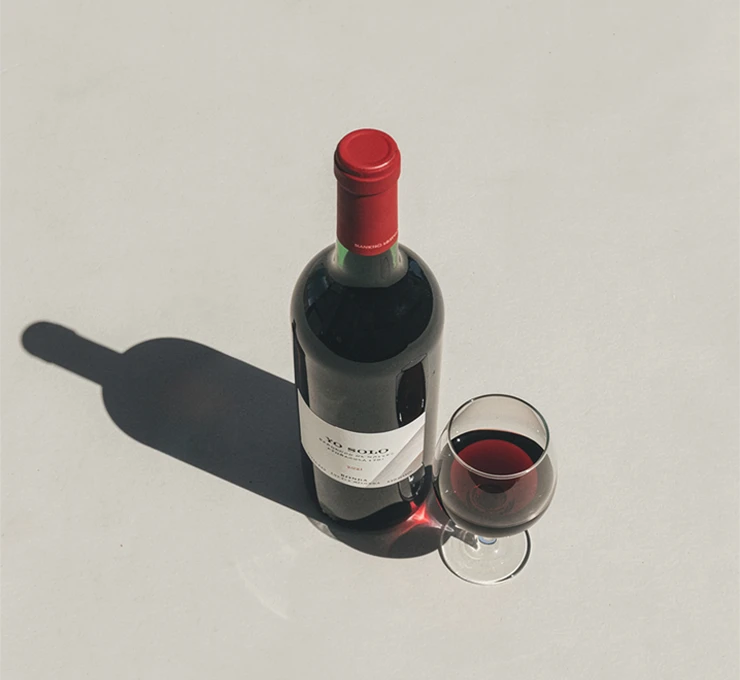
Yo Solo Wine by La Melonera
Yo Solo is the prestige red wine from La Melonera, and it’s unlike anything else being produced in the region. It comes in two versions. It changes by vintage. It scores 95 points from the Peñín Guide. And you won’t find it at Tesco.
Producer
La Melonera, Ronda (Andalusia, Spain)
Grape varieties
Tintilla de Rota, Blasco, Romé — blend varies by vintage (Red) · 100% Melonera (Melonera edition)
Style
Deep with dark fruit and spice (Red) · Lighter and aromatic (Melonera)
Price
€60 (Red) · €80 (100% Melonera)
Oak ageing
9–12 months, French oak (Allier)
What does "Yo Solo" mean?
“Yo Solo” is Spanish for “I Alone” — and it’s not just a name. It’s the motto on the coat of arms of Bernardo de Gálvez, a general from Málaga who, in the spring of 1781, did something so reckless it changed the course of history.
During the Siege of Pensacola in 1781, the Spanish fleet needed to sail through a narrow channel guarded by British cannons. The naval commander refused. Gálvez got on a small boat, sent the Admiral a used cannonball and a note — “Whoever has honour and valour will follow me” — and sailed through alone. The fort fired 27 shots at him. He anchored, fired a salute back, and the entire fleet followed the next day. King Carlos III gave him the “Yo Solo” motto on his coat of arms.
He died at 40. He has a statue two blocks from the White House. Most Spaniards have never heard of him.
The name also works on a second level: in Spanish, “Yo Solo autóctonas” — only indigenous varieties. La Melonera’s owner Jorge Viladomiu puts it simply: “Only indigenous varieties recovered by La Melonera. Tribute to Bernardo de Gálvez for contributing to the diffusion of Andalucía grapes in the New World.” No Cabernet Sauvignon, no Syrah — only the near-extinct native grapes the winery has spent 20 years rescuing.

The two versions of Yo Solo
There are two wines in the Yo Solo range. They’re related but very different, and it’s worth understanding what you’re choosing between.
| Characteristic | Yo Solo Red | Yo Solo 100% Melonera |
|---|---|---|
| Grapes | Varies by vintage — Tintilla de Rota, Blasco, Romé | 100% Melonera |
| Production | ~350 bottles/year | 357 bottles (first edition, Dec 2024) |
| ABV | 15% | 15% |
| Price | €60 | €80 |
| Ageing | 9–12 months, French oak (Allier) | French oak |
| Style | Deep, spiced, structured | Lighter, elegant, unique |
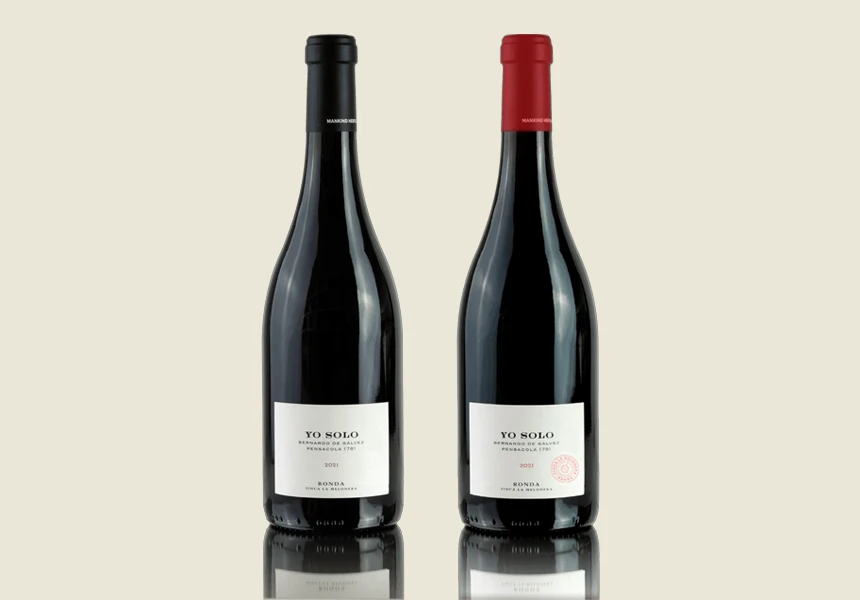
Yo Solo net on the left (black capsule), Yo Solo 100% melon net on the right (red capsule).
Yo Solo Red (the blend)
This is the original. It’s been produced for several vintages and the blend shifts each year as the winemaking team — led by oenologist Ana de Castro — tests different combinations of the recovered varieties.
The 2022 vintage uses Tintilla de Rota and Romé. Earlier vintages have included Blasco alongside the Tintilla. The blend isn’t fixed by design: the whole point is to learn how these varieties perform, which combinations work, and which deserve their own dedicated bottles down the line.
What stays constant is the character. Cherry red with violet hues. On the nose, dark fruit — blackberries, plums — with black pepper and a spicy edge. On the palate it’s silky, with ripe tannins that have been well integrated by the time you open it. The oak is present but not dominant; 9–12 months in medium-toasted Allier barrels adds texture rather than flavour. It finishes long.
The Peñín Guide has given it up to 95 points — a score reached by fewer than 150 wines in the whole of Spain.
At €60, it’s not cheap. But given what went into making it — the 20-year grape recovery project, the microscopic production, the critical scores — it’s one of the most interesting bottles of Spanish wine at that price point.
Yo Solo 100% Melonera
This is something genuinely historic.
In December 2024, La Melonera released 357 bottles of the first wine made entirely from the Melonera grape in approximately 150 years. It had taken 18 years of work to get there — sourcing plant material from a research station in Jerez, navigating 12 years of bureaucratic process with the Junta de Andalucía to have the variety officially recognised, and painstakingly learning how to vinify a grape that essentially nobody alive had ever worked with before.
If you want the full story of the Melonera grape — the phylloxera, the rediscovery, the survival in a few vines at a botanical garden — we’ve covered it in depth on the La Melonera winery page.
What we’ll say here is this: the wine it produces is not what you’d expect from Ronda. Ana de Castro calls it the most elegant wine they’ve made at the winery. It’s lighter in body, delicate, with a profile closer to aromatic dark fruit and a curious, persistent freshness. It moves away from the powerful, structured style that Ronda reds are known for — which is exactly what makes it interesting.
At €80 for a wine that exists in fewer than 400 bottles, it’s not a casual purchase. But there are very few wines in the world you can say that about — that this might be the only monovarietal bottling of this grape that has existed in living memory.
The grapes: what's actually in the bottle
Since the blend shifts by vintage, here’s a quick guide to the three varieties you’re most likely to encounter in Yo Solo.
Tintilla de Rota
The grape with the longest and most glorious history. Originally from Rota, on the Cádiz coast — and for centuries one of the most celebrated wines in Europe. It was served at English communion tables in the 1800s. Samuel Pepys mentioned it in his diary in 1664. González Byass won a gold medal with it at the 1867 Paris Universal Exposition.
Then it nearly vanished — partly because its yields are punishingly low (barely 800 grams per vine at La Melonera), partly because the military base at Rota literally paved over many of its historic vineyards in the 1950s.
In the glass, it gives extraordinary colour — deep red, almost black, with violet reflections. Lots of dark fruit, black pepper, a meaty, ink-like intensity. Naturally high acidity, which gives the wine freshness and structure. Tannins that are round and generous rather than aggressive.
There’s an ongoing debate about whether Tintilla de Rota is genetically the same as Graciano (the Rioja variety). DNA analysis suggests they share a genotype. Producers in Cádiz dispute this vigorously, pointing to the single seed, the sweeter tannins, and the entirely different flavour profile. In September 2025, Spain’s Ministry of Agriculture officially reclassified it as Graciano — and producers immediately pushed back. The argument continues.
Blasco
The most enigmatic of the three. A red variety rescued by La Melonera from the Rancho de la Merced research station in Jerez, also first documented by Rojas Clemente in 1807. Beyond that, relatively little is known.
What we can tell you from the wines is that it contributes dark fruit intensity, balsamic and herbal complexity, and good acidity. The 2017 Yo Solo (50% Tintilla, 50% Blasco) was described by critics as very balsamic, with ink and black fruit aromas and excellent structure. La Melonera plan to release a monovarietal Blasco under the Yo Solo label in a future vintage.
Melonera (in the 100% edition)
Covered extensively in our La Melonera winery guide. The short version: striped skin, nearly extinct, only officially recognised by Spain’s wine authorities in 2024. Makes a lighter, more aromatic wine than you’d expect. Candy-like, delicate, with tropical dark fruit.
Where to buy Yo Solo wine
Quick answer: not at a supermarket. If you’ve searched for Yo Solo in Tesco, we appreciate the optimism — but this is a 350-bottle-a-year wine. It isn’t going to be on the shelf at your local Tesco, or any other supermarket.
Here’s where you can actually get it:
Direct from the winery — the most reliable option, and the best for current-vintage availability. Head to lamelonera.com and order directly.
Vinissimus UK — one of the few UK-based retailers that consistently stocks La Melonera wines. They carry the main range and occasionally the Yo Solo when available.
Wine-Searcher — useful for tracking down specific vintages across European retailers. The Yo Solo Red appears at around €65–70 on the secondary market from European merchants; the 100% Melonera isn’t widely listed yet given the tiny production.
In person at the winery — if you’re visiting Ronda (and you should be), the Frontones Tour at La Melonera is one of the only ways to taste the Yo Solo before buying. It’s not poured at the standard visit.
One thing worth knowing: international pricing (especially in the US) tends to be higher. Wine-Searcher lists the Yo Solo at around $65–70 USD per bottle once you factor in import and distribution costs. If you can buy direct from the winery, it’s better value.
Is Yo Solo worth it?
We think the answer depends on what you’re looking for.
If you want a bottle to open on a Wednesday and drink with a steak — no. There are great Ronda reds at €12–25 that will make you very happy. Start with the Payoya Negra if you haven’t already.
If you want a wine that tells a genuine story — that connects an 18th-century naval battle in Florida, a nearly extinct Andalusian grape, and a mountain estate outside Ronda — and you want something you genuinely can’t buy anywhere else, then Yo Solo is the bottle.
The 100% Melonera in particular is the kind of thing you open for a specific occasion, pour carefully, and spend some time with. Not because it’s expensive, but because you’re drinking something that didn’t exist in the world until very recently.
That, to us, is what makes it interesting.
What is Yo Solo wine?
Yo Solo is a limited-edition red wine made by La Melonera, a winery in Ronda, southern Spain. It’s produced from indigenous Andalusian grape varieties that were nearly extinct — including Tintilla de Rota, Blasco, and the Melonera grape. Around 350 bottles are made per year. The name comes from the motto on the coat of arms of Bernardo de Gálvez, a Málaga-born general who helped the American colonies win independence.
Is Yo Solo wine available at Tesco?
No. Yo Solo is a small-production wine made in around 350 bottles per year. It is not sold in supermarkets. You can buy it directly from La Melonera’s website (lamelonera.com), through specialist Spanish wine retailers like Vinissimus UK, or via Wine-Searcher. If you’re visiting Ronda, you can also purchase it at the winery.
How much does Yo Solo wine cost?
The Yo Solo Red (the blend) is priced at €60 on the winery’s website. The Yo Solo 100% Melonera — a historic limited edition released in December 2024 — is priced at €80. International pricing via retailers tends to be slightly higher, typically $65–70 USD for the standard version.
What does Yo Solo wine taste like?
The Yo Solo Red is deep and structured — dark fruit (blackberries, plums), black pepper, and a long spiced finish. The tannins are ripe and silky, with good integration from oak ageing. The 100% Melonera is quite different: lighter, more aromatic, and more delicate than you’d expect from a Ronda red.
Sources: La Melonera official website — Yo Solo Red, La Melonera official website — Yo Solo 100% Melonera, Museum of the American Revolution — Bernardo de Gálvez, American Battlefield Trust — Bernardo de Gálvez biography, SherryNotes — Tintilla de Rota, Wine-Searcher — La Melonera Yo Solo, Vinissimus UK — Finca La Melonera