Bodega Vetas
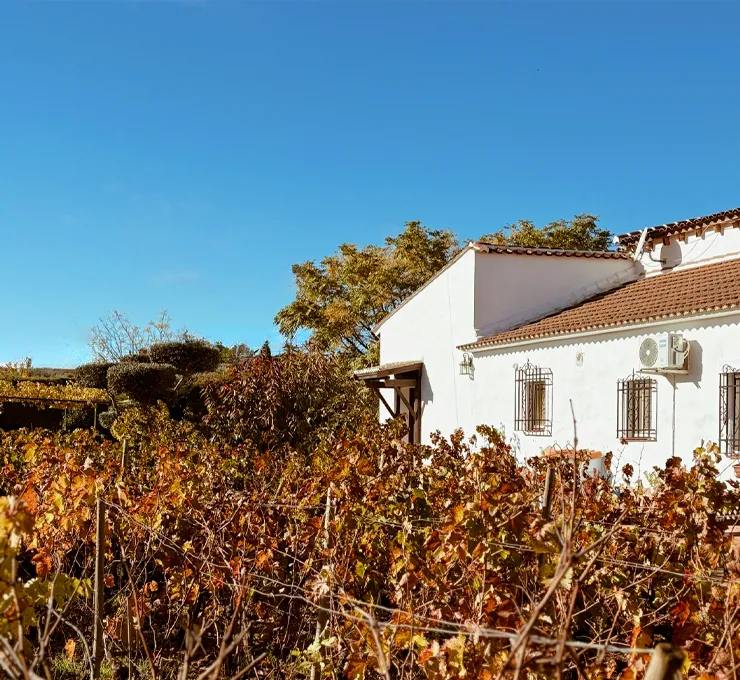
A family winery so small that Juan Manuel Vetas, the man who built it, once described it with a shrug: “Somos pequeños“. They are small. But what comes out of that single hectare in Arriate has just beaten 548 finalists from over 300 wineries across Spain. The Mar de Tethys 2010, tasted blind by a panel of 16 professional critics, scored 99 points. First place, no question.
Who is Juan Manuel Vetas
“I’ll tell you the story of the wines of Ronda,” says Juan Manuel Vetas at the start of the short film the family posted online. He has every right to narrate it. He was there from the beginning.
He was born in Ávila, in Castilla y León, but his parents emigrated to France when he was a child. He studied oenology there, worked his way through several Médoc châteaux, and by the late 1980s was at Château Prieuré-Lichine in Cantenac, working under Sacha Lichine.
In the early 1990s, Lichine entered a partnership with Prince Alfonso de Hohenlohe — the Spanish aristocrat who essentially invented luxury tourism on the Costa del Sol — to plant a Bordeaux-style vineyard at Hohenlohe’s estate. They needed someone who knew Médoc viticulture inside out. Lichine called Juan Manuel.
“They wanted to make a winery project in Spain,” Vetas explains, “in a virgin zone where the Romans had once made wine, but where everything had been lost. To recover the wines of the area.” He arrived in Ronda in 1991.
Cortijo Las Monjas: planting a region from scratch
The estate was Cortijo Las Monjas, and what Juan Manuel Vetas did there over the following years was, without exaggeration, the founding act of modern Ronda wine. He planted the first vines. He chose the varieties — Tempranillo, Syrah, Cabernet Sauvignon, Merlot, and, crucially, Petit Verdot. He was advised by Michel Rolland and collaborated with Carlos Falcó, the Marqués de Griñón, another early believer in Spain’s potential for Bordeaux varieties.
Within a few years, the wines from Cortijo Las Monjas were winning national and international medals. Ronda had gone from a region with no serious red-wine tradition to occupying the podium of the best wines in Spain.
Vetas also advised. Helped. Planted. Over the course of those first fifteen years, he personally planted approximately 70 % of the entire Ronda vineyard and consulted for the most important bodegas in the area.
And among all the varieties he brought to Ronda, one stood out. A grape that barely anyone in Spain was taking seriously at the time: Petit Verdot. A late-ripening Bordeaux variety that, in most of France, only exists as a small blending component. Juan Manuel Vetas, looking at Ronda’s altitude, its clay soils and its long, dry autumns, saw something else. He was the first person to plant Petit Verdot in Spain. And it worked.
Contact
- Phone: +34 647 177 620
- Email: info@bodegavetas.com
- Website: bodegavetas.com
Essentials
- Address: Pago Finca El Baco, Arriate, Málaga
- Vineyard: 1 hectare at 780m altitude
- Varieties: Petit Verdot, Cabernet Sauvignon, Cabernet Franc
The wines
Bodega Vetas makes six wines. All red or rosé. All from that one hectare.
Vetas Junior
The youngest wine in the range. A blend of Cabernet Sauvignon, Cabernet Franc and Petit Verdot, aged for six to ten months in third-fill French oak and then at least a year in bottle. It drinks well young: black forest fruit, violet, a balsamic note, smooth tannins. Around €12–14 at most outlets.
Vetas Rosé
Made by saignée — bleeding off the red fermentation tank at 20:30 on harvest day, then allowing a long, slow fermentation of up to twenty days at low cellar temperature to maximise aromatics. The result is a full-bodied, dry, raspberry-pink wine with structure that most Andalusian rosés don’t attempt. €12.
Vetas Colección
A more recent addition to the line-up. The same estate varieties, aged for six months in French oak and then a minimum of three years in bottle. Approachable at a younger age than the Selección, but still unmistakably Vetas. €68 at the bodega.
Vetas Selección
A Gran Reserva blend — roughly Cabernet Sauvignon, Cabernet Franc and Petit Verdot — aged for 18 to 24 months in semi-new French oak, then held in bottle for another three to five years. Juan Manuel refers to it as the “seductor” of the range: silky, floral, fully integrated.
It has scored 93 points in the Guía Peñín and won a Gold Medal at the Premios Mezquita 2011. €30–45.
Vetas Petit Verdot
This is the reference point. A 100 % Petit Verdot — the first monovarietal Petit Verdot ever bottled in Spain. Free-run juice only, no press wine. Fermented at 25°C with three weeks of post-fermentative maceration. Then 20 to 22 months in new French oak, followed by five to six years in bottle before release.
When the Petit Verdot 2008 went on sale in January 2016, the wine in the bottle was already eight years old. Juan Manuel is unapologetic about this: “My wines don’t leave until the Petit Verdot and Selección have a minimum of seven years, and the Petit Verdot with a minimum of eight, nine, ten years — or even twelve.”
Robert Parker gave the 2006 vintage 93 points. €37–45.
Vetas Mar de Tethys
Made only in exceptional vintages — in over twenty years of winemaking, just three vintages have qualified. Only two have been commercially released: 2010 and 2012.
It is 100 % Petit Verdot from Pago Finca El Baco. Free-run juice. Three weeks of maceration. Twenty-four months in new French oak. Then the wine goes into bottle and doesn’t come out again for nine to thirteen years.
The 2012 vintage was released in 2023 after nine years in bottle. The 2010 waited thirteen years before it was opened to the world.
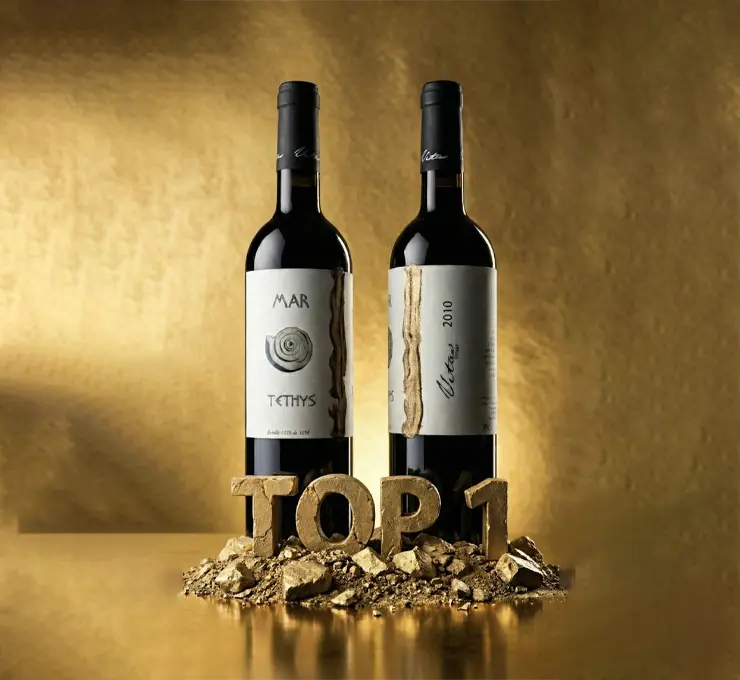
The name comes from the Tethys Sea that once covered this plateau. The label carries a physical strip of the vineyard’s clay soil and a drawing of the fossil shell found there.
Spain's best magnum wine
In April 2026, AkataVino published the results of the VI CIVAS (Concurso Internacional Akatavino Sumilleres de España) 2025. A panel of 16 professional tasters and critics from the Sociedad Española de Catadores Profesionales (SECP) had evaluated approximately 3,000 wines from 300+ nominated wineries across more than 60 Spanish production zones. Of those, 548 reached the finalist round. Only wines scoring 95 points or higher were considered for the Magnum Top 10.
Vetas Mar de Tethys 2010 scored 99 points and was named the Best Magnum Wine of Spain for 2026.
This is not a regional award. The wines it beat include a Solera Fina from Montilla-Moriles, a Fino from Toro Albalá, and wines from Rioja, Rías Baixas, Ribera del Duero and Mallorca. The highest score on the entire list. First place, from a winery with one hectare and no full-time employees.
It is also the second consecutive major AkataVino podium for Mar de Tethys: the 2012 vintage finished second in the best red wine of Spain ranking at CIVAS 2023, scoring 98 points.
You can read the full Top 10 at akatavino.
Mar de Tethys 2012 is available at €75 directly from the bodega; the 2010 at €120. The magnum format of the 2010 — the award-winning bottle — is available by contacting the bodega directly.
Visit options and prices
| Experience | Wines included | P.P. |
|---|---|---|
| 3-wine tasting | Colección or Rosé, Selección, Petit Verdot | €22 |
| 4-wine tasting | Colección, Rosé, Selección, Petit Verdot | €22 |
| Premium | Colección, Selección, Petit Verdot, Mar de Tethys | €44 |
| Premium Plus | Colección, Rosé, Selección, Petit Verdot, Mar de Tethys | €48 |
Maximum group size: 12 people. Extra experiences — paired lunches, sunset vineyard evenings — can be arranged on request.
How to book: Email info@bodegavetas.com or WhatsApp +34 647 177 620. Online booking is also available at bodegavetas.com.
Getting there: Pago Finca El Baco, Camino Nador s/n, 29350 Arriate. From Ronda, head towards Arriate on the A-369; the winery is signposted from the village. About 10 minutes from Ronda by car.
FAQ
What makes Bodega Vetas different from other Ronda wineries?
Two things set it apart. First, it is almost certainly the smallest registered winery in the Serranía de Ronda subzone — one hectare, fewer than 6,000 bottles a year. Second, it is the birthplace of Petit Verdot in Spain: founder Juan Manuel Vetas was the first person to plant the variety commercially in the country, and the winery’s entire identity is built around it. Every wine in the range contains Petit Verdot; the Mar de Tethys and the monovarietal Petit Verdot are made from nothing else.
What is the Mar de Tethys and why is it so expensive?
Mar de Tethys is the winery’s flagship — a 100 % Petit Verdot from Pago Finca El Baco, made only in exceptional vintages (three times in over twenty years), aged for 24 months in new French oak and then held in bottle for nine to thirteen years before release. Production is around 1,500–1,700 standard bottles per vintage. The 2010 magnum was named the Best Magnum Wine of Spain 2026 by AkataVino, scoring 99 points from a panel of 16 professional SECP critics. The 2012 costs €75; the 2010, €120.
Do I need to book in advance to visit Bodega Vetas?
Yes, all visits are strictly by prior reservation — the bodega does not accept walk-ins. Contact the family by email at info@bodegavetas.com or on WhatsApp at +34 647 177 620, or book online via the FareHarbor widget on bodegavetas.com. Visits are private and hosted in Spanish, English or French. Maximum group size is 12.
Can I taste Mar de Tethys on a visit?
Yes. The Premium (€44/person) and Premium Plus (€48/person) visit options include Mar de Tethys in the tasting. This is almost certainly the only way to taste it outside of a handful of specialist restaurants — production is too small for normal distribution.
Where can I buy Vetas wines outside of Spain?
The bodega sells directly from its website at bodegavetas.com and ships across Spain and internationally on request. Wine tourism visits at the bodega account for a significant share of sales, and many bottles find their way abroad in visitors’ luggage. Specialist Spanish wine merchants in the UK and Germany do occasionally stock the Petit Verdot and Selección; check Wine-Searcher for current listings.
Is Bodega Vetas certified organic?
The winery’s viticulture is organic in practice — no synthetic pesticides, herbicides or fungicides — and the cellar work is natural-style, with bottling without filtration or fining and minimal sulphite use. The family describes their wines as “vino natural.” A formal third-party organic certification (CAAE or EU bio) is not currently displayed by the bodega; if this is important to you, confirm directly with the family before visiting.
How far is Bodega Vetas from Ronda?
Around 10 minutes by car. Arriate is 8 km from Ronda on the A-369. The winery is just outside the village, signposted from the main road. If you are planning a day of wine tourism in the Serranía de Ronda, Bodega Vetas pairs naturally with a morning visit to Ronda town and lunch before the afternoon tasting.