Descalzos Viejos
The barrel room used to be a chapel. The frescoes are still there — Santas Justa and Rufina, painted in the 16th century, staring down from the high altar at rows of French oak barrels. It is, without question, one of the most extraordinary places in southern Spain to drink wine.
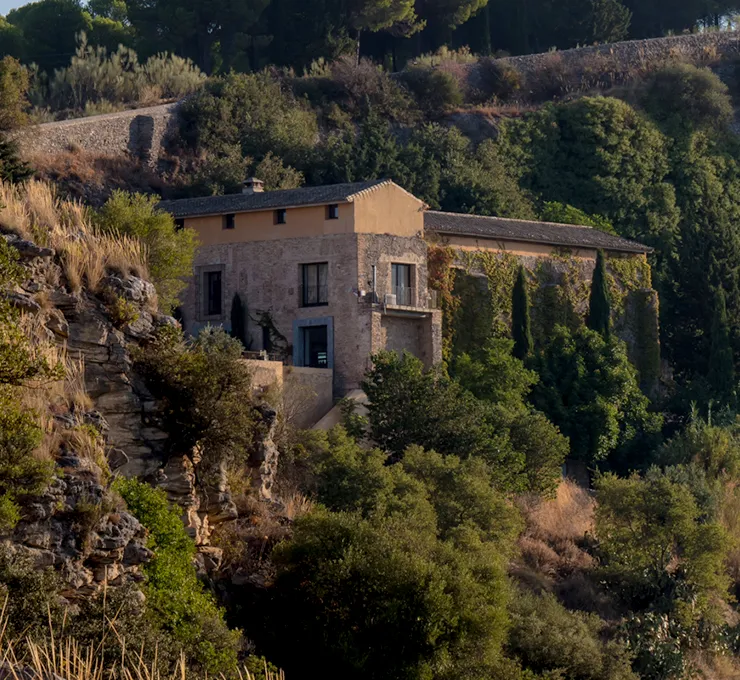
A convent, two architects, and no plan
“Architect by accident of birth,” says Flavio Salesi, “and winery owner by coincidence.”
It is not entirely self-deprecating. Flavio is Italo-Argentine — born in the working-class Buenos Aires barrio of La Boca, trained as an architect, arrived in Spain decades ago with no plan to make wine. His business partner, Málaga-born Paco Retamero, had been sharing a studio with him for over twenty-five years when they found the property.
They were not looking for a winery. In 1998, they came across an abandoned Trinitarian convent on the edge of Ronda’s Tajo gorge. They bought it, as Flavio tells it, “simply because there was enormous beauty there.” They were in their thirties. The architecture studio was busy. They didn’t stop to think too much about the future or the economics.
Paco’s wife Chelo and Flavio’s wife Mariela — both doctors — came on board. The four of them began what would become, with the benefit of hindsight, one of the most interesting wine projects in Andalucía.
Today Flavio lives on the finca full-time. The architecture studio still operates from a space above the bodega. When asked to name a more special place, he pauses: “It is the place in Ronda and in the world. I would have to think for a very long time.”
From ruins to winery
When they took ownership, there were no vines. There were ruins of the original church, the monks’ cells, a small dispersed olive grove — and very little else. During the restoration works, something unexpected appeared beneath the earth: an Arab irrigation system, intact and centuries old.
As architects, the building was, as Flavio acknowledges, “the easier part.” The field was more uncertain. They planted vines on the lower sections of the estate, rehabilitated the church into what is now the barrel room, and gradually assembled a working winery, an event space, and a private home within the same ancient walls.
The restoration work received a Mención de Rehabilitación at the Premios Málaga de Arquitectura 2007, awarded by the Colegio Oficial de Arquitectos de Málaga. For two architects turned winemakers, that recognition still matters.
Contact
- Phone: +34 952 874 696
- WhatsApp: +34 607 167 482
- Mail: info@descalzosviejos.com
- Web: descalzosviejos.com
- Instagram: @descalzosviejos
Essentials
- Address: Partido de los Molinos, Ronda, Málaga
- Estate: 16 hectares
- Altitude: 600–650m above sea level
- DO: Sierras de Málaga
The wines
Six wines in the current range. One white, five reds. Around 35,000–40,000 bottles per year, roughly 90% red. All are DO Sierras de Málaga, subzona Serranía de Ronda.
DV Chardonnay
The only white in the range, and the hardest to get. “It’s always pre-sold,” says Flavio. It does not sit on shelves. It is gone before it is bottled.
100% Chardonnay from the Huerto del Mellizo parcel — the coolest, highest-clay plot on the estate. Partially fermented in 500-litre barrels with bâtonnage, then aged three months on the lees. Pale gold, apricot and peach, clean marked acidity. The kind of white that makes you reconsider what the south of Spain can do.
Around €15–20.
DV Aires
The most age-worthy of the commercial range. Petit Verdot-dominant, with Garnacha. Sixteen months in French oak, a minimum of two years in bottle before release. Around €27.
DV
The entry-level red and the largest production cuvée — roughly 10,000 bottles per year. A blend of Garnacha, Syrah and Merlot, with six months in predominantly French oak followed by time in bottle. Balsamic, red fruit, easy tannins.
The wine you open on a Tuesday. Around €12–15.
DV+
The estate classic. Around 4,000 bottles per year — in vintages where Vicente considers the quality good enough to make it at all.
A Graciano-dominant blend with Merlot and a small proportion of Cabernet Sauvignon. Twelve months in oak, a minimum of twelve months in bottle. It is a wine “with a lot of power,” as Vicente says, “but with much more clay” — meaning structure that rewards patience. Not a wine to rush.
Gold Medal at the Concours Mondial de Bruxelles for the 2005 vintage. Grand Gold Medal for the 2006.
Around €19–23.
DV Las Santas Iusta
One of two limited-edition monovarietals. Production is 1,500–2,000 bottles per vintage — and there are vintages where this wine simply is not made.
100% Garnacha, hand-picked, fermented and macerated with part of the grape stems. Sixteen months in large-format 500-litre barrels — “we want the parcel to matter more than the barrel,” says Vicente. Minimum one year in bottle. Cherry colour, taut mineral acidity, balsamic.
The name is taken from the fresco directly overhead in the barrel room — spelled in the older Latin form, Iusta, because the wine felt like it warranted the full title.
Around €35.
DV Las Santas Rufina
The companion piece. 100% Syrah, whole-bunch fermentation. Sixteen months in large-format barrels — but here, the barrels have been previously seasoned with Axarquía sweet wine, the dessert wine of the Málaga coast. A unique technique that adds a layer of oxidative complexity without a trace of sweetness.
Violet colour, balsamic and mentholated on the nose, mineral on the palate. It drinks beneath the eyes of the saint it is named after, in the fresco above the altar.
Around €41–45.
A note on Dimitri
There is a seventh wine, but you will not find it on any shelf. Dimitri is a 100% Chardonnay aged biologically under flor — in the tradition of Jerez and Montilla, but made here at altitude in the Serranía de Ronda, making it the first wine of its kind in the region. A handful of bottles per year, produced quietly for six years before anyone outside the bodega knew it existed. It is sold exclusively to Bardal, the two-Michelin-star restaurant in Ronda headed by chef Benito Gómez. If you want to try Dimitri, book a table at Bardal.
How they farm
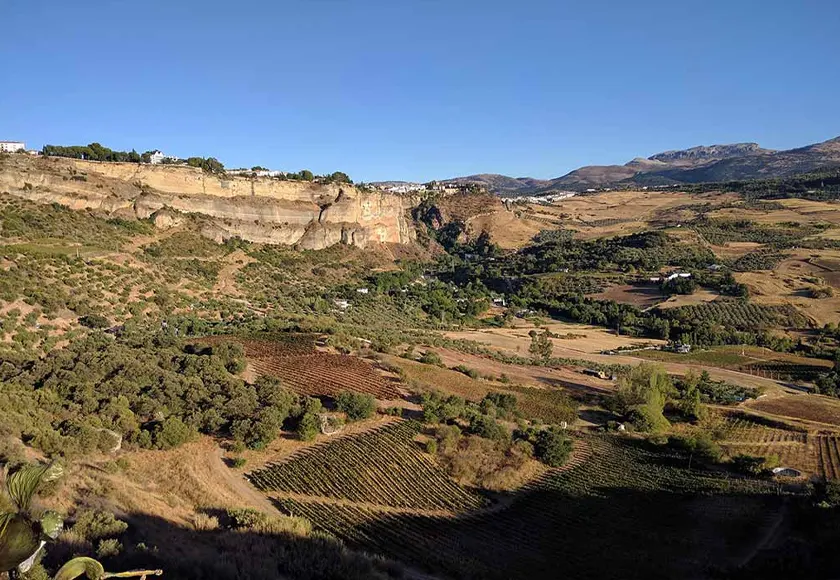
The 16-hectare estate has around 10 hectares of vineyard across three plots at 600–650 metres above sea level, plus additional plots farmed in collaboration with neighbouring producers — with Descalzos Viejos managing the viticulture and selecting the varieties planted.
The enologist is Vicente Inat, Valencian by birth, and he has been here fifteen years. Along with Flavio, Paco, and the core team — Rafael, Antonio, Begonia — the people making the wine have barely changed since the beginning. “The team working on this project is the same team from fifteen years ago,” says Flavio, “not counting the five years before that.”
The farming is organic in practice, though not certified. Sheep graze between the vine rows to manage vegetation and enrich the soil. 95% of field work is done by hand. Native yeasts only. Night harvesting across every parcel — not just the premium plots.
On certification, Flavio is characteristically direct: “A logo, a seal — obviously — but the work comes first. We’ve been farming organically for seven years and we’ve changed a great deal. A seal is also a commercial strategy. If a German buyer pays double because of the seal and buys your whole production — maybe that changes things. But it’s part of the decisions you make day to day.”
Vicente puts the climate in useful perspective: “We’re 20 kilometres from the Sahara. We had to stop applying French viticulture here and adapt it to what we actually have.” What they have: extreme summer heat, cold nights, limestone and clay soils, and three natural parks on the horizon. The central challenge now — for this generation and the next — is making wines that are fresher, more elegant, and lower in alcohol. “It seems like a simple sentence,” says Vicente. “It is very difficult.”
Visiting Descalzos Viejos
| Experience | What's included | Price |
|---|---|---|
| Tour + tasting | Full visit, cellar tour with frescoes, 3 wines + cheese & charcuterie | ~€45 pp |
| Helicopter | Marbella–Ronda return + 2-hour private tour & tasting | €3,750. Up to 4 guests |
Visits are by prior appointment only. No walk-ins. Flavio lives here — it is a private home as much as a winery — and that sets the tone entirely. You arrive as a guest.
Whoever receives you will be someone who actually makes the wine: Flavio, Paco, or Vicente. “We always receive visitors with Miguel, Vicente or me,” as Flavio puts it. No hired guide. No scripted tour. The visit reflects the place: direct, personal, and unhurried.
The visit typically includes a walk through the gardens, orchards and the Arabic water features; a view of the lower vineyard from the cliff edge above the Tajo; a tour of the working cellar inside the former chapel — with the frescoes lit above the barrels — and a tasting of three wines with local Payoyo cheese and jamón. Groups up to around 30; couples and individuals welcome.
The bodega also hosts live music throughout the year — jazz, flamenco, tango — in the chapel space and the gardens. Flavio does not draw a line between wine, music, architecture and family. “I’ve always been the same person for everything,” he says. It shows in the place.
The helicopter option is operated by HeliAir Marbella and is listed here for completeness. Most people take the forty-minute drive from Marbella or the five-minute taxi from central Ronda and find it quite sufficient.
How to book: Phone +34 952 874 696, WhatsApp +34 607 167 482, or email info@descalzosviejos.com. No fixed public opening hours — always confirm before visiting.
Getting there: The bodega is around 3 kilometres from central Ronda — a 25-minute walk downhill from the old town along the river valley, or five minutes by taxi. By car: take the A-374 towards Grazalema, then follow the sign on the left; the dirt access track is well-signposted but GPS navigation can misroute you. Follow the Grazalema road signs rather than the GPS.
FAQ
What is Bodega Descalzos Viejos?
Descalzos Viejos is a small, family-owned winery in Ronda, Málaga, housed inside a restored 16th-century Trinitarian convent on the edge of the Tajo gorge. Founded in 2000 by architects Flavio Salesi and Paco Retamero, who bought the abandoned building in 1998 and converted it into a working winery. The barrel room is the original chapel, with intact 16th-century frescoes of Santas Justa and Rufina above the barrels. The bodega produces around 35,000–40,000 bottles per year across six wines under DO Sierras de Málaga — Serranía de Ronda.
How do I visit Descalzos Viejos?
All visits are by prior appointment only — no walk-ins. Contact the bodega by phone (+34 952 874 696), WhatsApp (+34 607 167 482) or email (info@descalzosviejos.com) to arrange a date and time. The standard visit — a tour of the convent, cellar and frescoes followed by a three-wine tasting with local cheese and cured meats — costs approximately €45 per person plus VAT. Visits are led personally by the owners or the enologist.
What wines does Descalzos Viejos make?
Six wines: one white (DV Chardonnay — always pre-sold before bottling) and five reds: DV (the everyday red blend), DV+ (Graciano-dominant, two Concours Mondial de Bruxelles gold medals), DV Aires (Petit Verdot + Garnacha, 16 months in oak), DV Las Santas Iusta (100% Garnacha) and DV Las Santas Rufina (100% Syrah, aged in Axarquía sweet wine-seasoned barrels). There is also a seventh wine, Dimitri — a biologically aged Chardonnay under flor, the first of its kind in the Serranía de Ronda — sold exclusively to restaurant Bardal in Ronda.
Are Descalzos Viejos wines organic?
The vineyard has been farmed organically for at least seven years — no synthetic pesticides or herbicides, native yeasts in the cellar, sheep grazing between the rows, and 95% manual field work. The bodega does not currently hold a third-party organic certification. Flavio describes certification as “a commercial strategy” — one they respect in others but have not pursued. If this matters to you, contact the bodega directly to confirm current practice before visiting.
Where can I buy Descalzos Viejos wines in the UK?
There is no dedicated UK importer at the time of writing. The most reliable options are Vinissimus (a Spanish wine merchant that ships to the UK), the bodega’s direct online shop at descalzosviejos.shop, or a case purchased at the end of your visit. Many bottles make the journey home in luggage — and are considerably better for the story attached to them.
How far is Descalzos Viejos from central Ronda?
Around 3 kilometres — a 25-minute walk downhill from the old town, or five minutes by taxi. The bodega sits on the lower cliff face of the Tajo gorge, which means the walk back up to Ronda after a tasting is brisk. The sensible approach: walk down, take a taxi back.