Pago El Espino by Cortijo Los Aguilares
In Bordeaux, Petit Verdot is a seasoning. Winemakers add one or two per cent of it to a blend the way you’d add a pinch of salt — for colour, for tannin, as a finishing touch. It rarely ripens fully. In a bad year they don’t bother. And yet five kilometres from Ronda, at 900 metres above sea level, a winery has been making it the star of the show for over two decades. Pago El Espino is built on 73–74% Petit Verdot. It scores 93 points from Guía Peñín and James Suckling. It costs around €23. And it’s one of the most distinctive red wines in Spain.
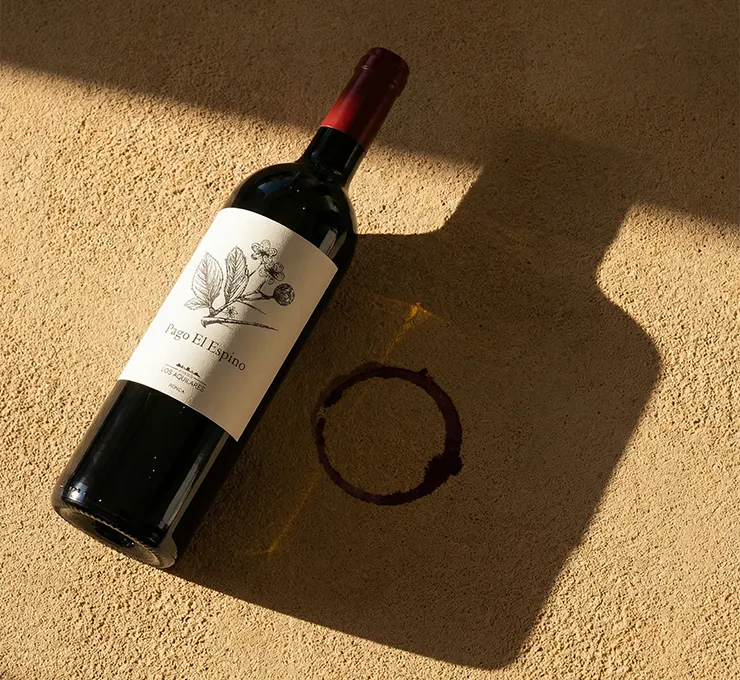
Pago El Espino is the flagship red wine of Cortijo Los Aguilares, an organic estate in the Serranía de Ronda. It’s a blend of three grape varieties — roughly 73–74% Petit Verdot, 15–17% Syrah, and 10–11% Tempranillo — aged for 15 months in large-format French oak barrels.
It sits in the middle of the estate’s range: above the entry-level Tinto CLA (no oak, around €12), below the pure Petit Verdot Tadeo (€44) and the celebrated Pinot Noir (€42). With around 40,000 bottles produced per year — the highest of any wine in the range — it’s the most available Cortijo Los Aguilares wine internationally.
“Pago” is an old Castilian word for a named vineyard parcel, equivalent to a French lieu-dit. “El Espino” means “the hawthorn” — almost certainly the name of the specific plot on the estate where hawthorn grows. It has nothing to do with the Spanish legal classification Vino de Pago (a separate, entirely distinct designation that doesn’t exist in Andalucía).
What does it taste like?
Deep cherry-garnet in the glass with a violet rim. The nose is generous without being obvious: ripe forest fruits (blackberry, blackcurrant, dark cherry), balsamic and herbal notes — thyme, rosemary, a whisper of eucalyptus — then a subtle thread of toast and spice from the oak. Nothing here is heavy-handed.
On the palate it’s fresh. That surprises people. They expect something dense and warm from Andalucía; they get something lively, with natural acidity that pushes the wine forward rather than sitting flat. Tannins are ripe and fine-grained — firm enough to give structure, smooth enough to drink without food. The finish is long, clean, slightly smoky.
If you’re used to Rioja or Ribera del Duero, this tastes different. The fruit profile is darker, the herbal character is more pronounced, and there’s a minerality underneath everything — the limestone in the soil, expressing itself in the glass.
Serve at: 16–17°C. Decant for 30–60 minutes (longer for the most recent vintages). Use a large Bordeaux-style glass.
Why Petit Verdot works here — when it barely works in Bordeaux
This is the question worth asking, because the answer tells you everything about what makes Ronda unusual.
Petit Verdot — “little green one” in French — earned its name for good reason. In Bordeaux, it ripens properly only in warm, generous vintages. Most years it doesn’t fully mature. After phylloxera and the devastating 1956 frost, most Bordeaux producers ripped it out in favour of Merlot. Today it’s a minority component in Médoc blends: one or two per cent, occasionally up to five or ten in exceptional years. Under-ripe, it produces harsh, bitter tannins and sharp acidity. Winemakers use it with extreme caution.
So why does Cortijo Los Aguilares build their most-produced wine around 73% of it?
Because every problem Bordeaux has with Petit Verdot, Ronda solves.
The ripening problem: The Serranía de Ronda gets 3,000 hours of sun per year. Summer days hit 28–33°C. Petit Verdot — no matter how late-ripening — matures reliably here, every single year.
The over-ripeness problem: At 900 metres altitude, the temperature drops by 20–25°C between day and night during the growing season. Cool air descends from Sierra de las Nieves every evening, slamming the brakes on the vines and preserving natural acidity. Without this, all those warm sunny days would produce overripe, jammy fruit. With it, you get concentration and freshness — which is the whole point.
The disease problem: July rainfall in Ronda is approximately 2mm. Total. The bone-dry summer eliminates rot and mildew risk entirely, so late-ripening varieties can hang on the vine without risk until October.
The soil problem: The estate’s clay-limestone soils were studied by Claude and Lydia Bourguignon — the renowned French soil scientists used by top Burgundy estates. They found chalky areas alternating with clay, abundant stone and quartz. Limestone encourages acidity retention. Clay retains moisture through the dry summer and creates moderate vine stress that concentrates flavour in thick-skinned, small berries.
The challenge for winemaker Bibi García — who has run Cortijo Los Aguilares since 2007 — is the exact inversion of Bordeaux’s dilemma. As Spanish Wine Lover puts it, the estate’s task is “to rein in Petit Verdot’s natural concentration and structure and search for elegance.” The grape doesn’t need help ripening here. It needs restraint.
How it's made
The gravity-flow winery
The bodega is built on multiple descending levels so grapes travel downwards from arrival to bottle without mechanical pumps. Every stage — sorting, destemming, fermentation, barrel ageing — happens by gravity. This prevents bruising, avoids over-extraction, and produces softer tannins and better aromatics. It’s a more expensive way to build a winery. The wines benefit directly from it.
Cold storage at 2°C
Grapes arrive at the winery and go straight into a refrigeration room at 2°C for 24 hours. The main purpose, as documented in the winery’s process notes, is to minimise sulfite additions — cold grapes resist spoilage naturally, reducing the need for SO₂. It also functions as a pre-fermentation cold soak, encouraging gentle colour and aromatic extraction before alcohol-driven extraction begins.
Why large barrels matter
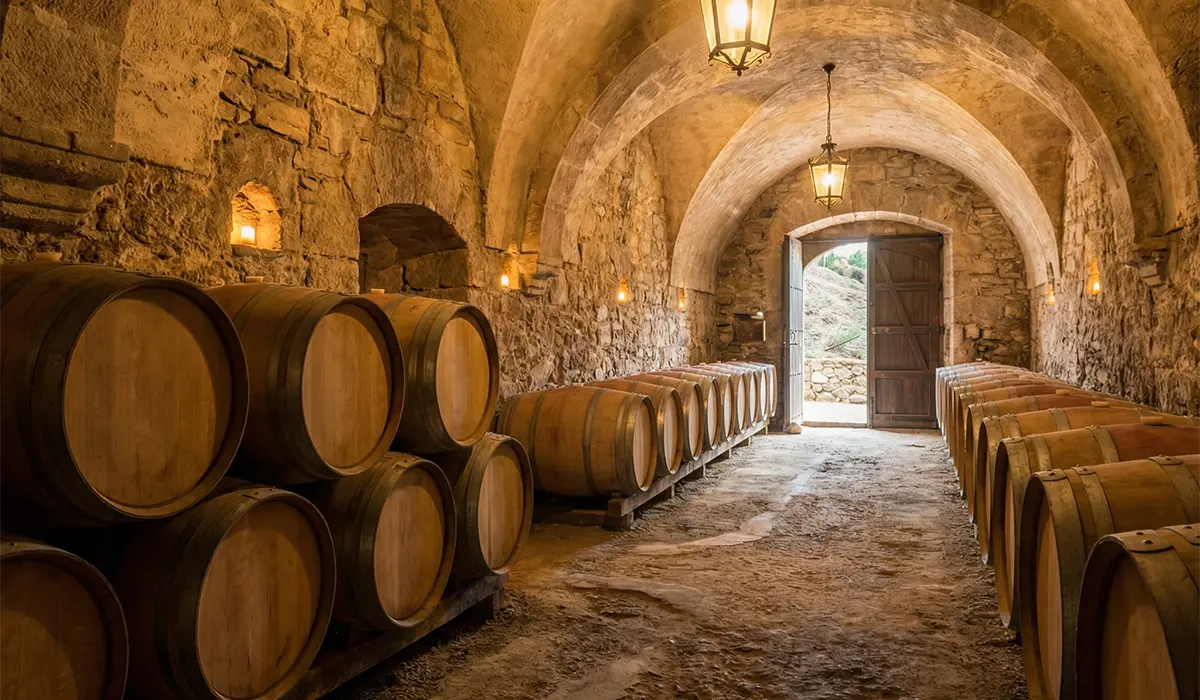
The wine ages for 15 months in French oak — but in 300–500 litre barrels rather than the standard 225L Bordeaux barrique. The winery is explicit about this choice: larger barrels have a lower surface-area-to-volume ratio, meaning less oak flavour transfers into the wine. You get the structural benefit of slow oxidation and gentle tannin integration without the wine tasting primarily of toast and vanilla.
It’s the difference between oak as a tool and oak as a flavour. Bibi García uses it as a tool.
Malolactic fermentation in concrete
After primary fermentation, the wine undergoes malolactic fermentation in concrete tanks rather than in stainless steel or oak. Concrete is thermally stable — important for the temperature-sensitive bacteria involved — and is flavour-neutral. It doesn’t add anything. The point is to preserve what’s already in the wine: the terroir character, the fruit, the mineral backbone of the limestone soil.
Vintage guide
| Vintage | Character | Drinking window |
|---|---|---|
| 2017 | Frost and drought cut yields sharply, concentrating the wine. Highest-scored vintage (Peñín 93, Suckling 93). More structured, more tension. | Drinking well now, will hold |
| 2018 | Cooler, wetter year. Greater freshness, slightly lower alcohol, pronounced aromatics. Peñín 92. | At peak now |
| 2019 | Warm, dry. Tricky flowering limited yields but quality was high. Wine-Searcher aggregate: 91. | At peak now |
| 2020 | Wet first half, stronger second half. Juicy, fruit-forward. | Drinking well now |
| 2021 | Warm, dry season. Good concentration. Peñín 93. | Approachable, best 2026–2027 |
| 2022 | One of the hottest on record. Earliest harvest. Concentrated. | Needs 12–18 months, best 2026–2028 |
| 2023 | Four summer heat waves. Earliest harvest ever recorded in Ronda. Reported as more floral and deeper than 2022. | Hold until 2026–2027 |
One pattern is consistent: drought years in Ronda tend to produce the better wines. Lower yields concentrate everything. The 2022 and 2023 vintages were difficult for yields but promising for quality.
Critical scores
- Guía Peñín (Spain’s leading wine guide): 93/100 for 2017 and 2021; 92/100 for 2018; 94/100 noted for at least one recent vintage
- James Suckling: 93/100 for 2015 (“intensity of tannins, the complexity of its fruity aromas and its freshness, characteristic of the Serranía de Ronda, combine perfectly”)
- Robert Parker / Wine Advocate: 90/100
- Wine-Searcher aggregate across all vintages: 90/100
- Vivino: 4.1/5 from community reviews
It is also stocked by Tanners Wines — one of Britain’s most respected independent merchants, established in 1842 — at £25.50 for the 2023 vintage. That kind of placement is a quality signal in itself. Tanners don’t list wines for the sake of it.
How does Pago El Espino taste?
Deep garnet with violet tones. On the nose: blackberry, dark cherry, balsamic and herbal notes (thyme, rosemary), subtle toast and spice from the oak. On the palate it’s lively and fresh — firmer than most Rioja Crianzas but with a cleaner, more mineral finish. Alcohol runs 14–14.5%.
What's the difference between Pago El Espino and Tadeo?
Both are Cortijo Los Aguilares wines built on Petit Verdot. Pago El Espino is a three-variety blend (~40,000 bottles, €23) designed to express the estate’s overall terroir — approachable, fresh, and well-rounded. Tadeo is 100% Petit Verdot (~6,000 bottles, €44): more powerful, more mineral, more oak-influenced. If you haven’t tried either, start with Pago El Espino.
What scores has Pago El Espino received?
The 2017 and 2021 vintages both scored 93 points from Guía Peñín, Spain’s leading wine guide. The 2015 scored 93 from James Suckling. Robert Parker’s Wine Advocate awarded it 90 points. Wine-Searcher’s cross-vintage aggregate sits at 90/100.
What food goes best with Pago El Espino?
Lamb is the natural pairing — ideally slow-roasted with thyme and rosemary, which mirror the wine’s herbal character. Rabo de toro (braised oxtail) is the Ronda classic. Game birds, venison, aged Manchego, and jamón ibérico all work well. Serve at 16–17°C after 30–60 minutes of decanting.
Is Pago El Espino suitable for ageing?
Yes, though it’s accessible young. Most vintages are approachable after 2–3 years, with a comfortable drinking window of 8–10 years from harvest. Structured years like 2017 and 2022 will reward a few extra years in the cellar.
This article is part of our ongoing series on the wineries and wines of Ronda. For the full story on the estate behind Pago El Espino — its founder, its infamous Pinot Noir, and the winemaker who made it work — read our guide to Cortijo Los Aguilares.